Orchid Kingdom Phylum Class Order Family Genus Species
| Orchidaceae Temporal range: Belatedly Cretaceous – Recent | |
|---|---|
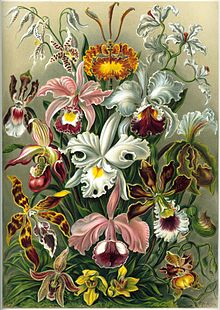 | |
| Colour plate from Ernst Haeckel's Kunstformen der Natur , 1906 | |
Scientific classification  | |
| Kingdom: | Plantae |
| Clade: | Tracheophytes |
| Clade: | Angiosperms |
| Clade: | Monocots |
| Lodge: | Asparagales |
| Family: | Orchidaceae Juss.[1] |
| Type genus | |
| Orchis Tourn. ex L. | |
| Subfamilies | |
| |
 | |
| Distribution range of family Orchidaceae | |
Orchidaceae ( or-kə-24-hour interval-shee [ commendation needed ]), commonly called the orchid family unit, is a diverse and widespread family of flowering plants, with blooms that are often colourful and fragrant.
Forth with the Asteraceae, they are one of the two largest families of flowering plants. The Orchidaceae have about 28,000 currently accepted species, distributed in about 763 genera.[two] [three] The determination of which family is larger is still nether fence, because verified data on the members of such enormous families are continually in flux. Regardless, the number of orchid species is most equal to the number of bony fishes, more than twice the number of bird species, and about four times the number of mammal species.
The family encompasses near half-dozen–eleven% of all seed plants.[4] The largest genera are Bulbophyllum (2,000 species), Epidendrum (i,500 species), Dendrobium (ane,400 species) and Pleurothallis (1,000 species). Information technology besides includes Vanilla (the genus of the vanilla plant), the type genus Orchis, and many commonly cultivated plants such as Phalaenopsis and Cattleya. Moreover, since the introduction of tropical species into cultivation in the 19th century, horticulturists have produced more than 100,000 hybrids and cultivars.
Description [edit]
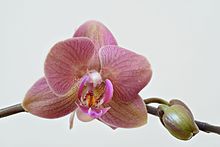
Orchids are hands distinguished from other plants, as they share some very evident derived characteristics or synapomorphies. Among these are: bilateral symmetry of the flower (zygomorphism), many resupinate flowers, a nearly e'er highly modified petal (labellum), fused stamens and carpels, and extremely small seeds.
Stalk and roots [edit]
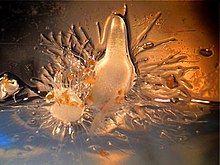
Germinating seeds of the temperate orchid Anacamptis coriophora. The protocorm is the get-go organ that volition develop into truthful roots and leaves.
All orchids are perennial herbs that lack whatsoever permanent woody structure. They can abound co-ordinate to ii patterns:
- Monopodial: The stem grows from a single bud, leaves are added from the apex each twelvemonth, and the stem grows longer appropriately. The stem of orchids with a monopodial growth can reach several metres in length, as in Vanda and Vanilla.
- Sympodial: Sympodial orchids take a front (the newest growth) and a back (the oldest growth).[v] The institute produces a serial of adjacent shoots, which abound to a certain size, bloom and and so stop growing and are replaced. Sympodial orchids grow horizontally, rather than vertically, following the surface of their support. The growth continues by development of new leads, with their own leaves and roots, sprouting from or side by side to those of the previous yr, as in Cattleya. While a new pb is developing, the rhizome may start its growth once more from a so-called 'eye', an undeveloped bud, thereby branching. Sympodial orchids may have visible pseudobulbs joined by a rhizome, which creeps along the top or just beneath the soil.
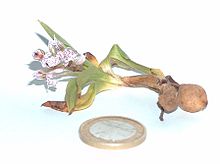
Terrestrial orchids may exist rhizomatous or grade corms or tubers. The root caps of terrestrial orchids are smooth and white.
Some sympodial terrestrial orchids, such equally Orchis and Ophrys, have 2 subterranean tuberous roots. One is used equally a nutrient reserve for wintry periods, and provides for the development of the other one, from which visible growth develops.
In warm and constantly humid climates, many terrestrial orchids exercise not need pseudobulbs.
Epiphytic orchids, those that grow upon a support, accept modified aerial roots that can sometimes be a few meters long. In the older parts of the roots, a modified spongy epidermis, chosen a velamen, has the function of arresting humidity. Information technology is fabricated of dead cells and can accept a silverish-grey, white or dark-brown appearance. In some orchids, the velamen includes spongy and gristly bodies virtually the passage cells, chosen tilosomes.
The cells of the root epidermis grow at a right angle to the axis of the root to allow them to go a business firm grasp on their support. Nutrients for epiphytic orchids mainly come from mineral grit, organic detritus, brute debris and other substances collecting among on their supporting surfaces.
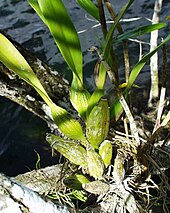
The pseudobulb of Prosthechea fragrans
The base of operations of the stem of sympodial epiphytes, or in some species substantially the entire stem, may exist thickened to form a pseudobulb that contains nutrients and water for drier periods.
The pseudobulb has a smoothen surface with lengthwise grooves, and tin can have different shapes, frequently conical or oblong. Its size is very variable; in some small species of Bulbophyllum, it is no longer than ii millimeters, while in the largest orchid in the earth, Grammatophyllum speciosum (giant orchid), it can reach three meters. Some Dendrobium species have long, canelike pseudobulbs with short, rounded leaves over the whole length; another orchids accept subconscious or extremely small pseudobulbs, completely included inside the leaves.
With ageing the pseudobulb sheds its leaves and becomes dormant. At this stage information technology is often called a backbulb. Backbulbs still hold nutrition for the plant, simply and so a pseudobulb usually takes over, exploiting the last reserves accumulated in the backbulb, which eventually dies off, too. A pseudobulb typically lives for about five years. Orchids without noticeable pseudobulbs are as well said to have growths, an individual component of a sympodial plant.
Leaves [edit]
Like virtually monocots, orchids by and large have simple leaves with parallel veins, although some Vanilloideae take reticulate venation. Leaves may be ovate, lanceolate, or orbiculate, and very variable in size on the private institute. Their characteristics are often diagnostic. They are normally alternating on the stem, oft folded lengthwise forth the centre ("plicate"), and have no stipules. Orchid leaves frequently accept siliceous bodies chosen stegmata in the vascular bundle sheaths (not nowadays in the Orchidoideae) and are fibrous.
The construction of the leaves corresponds to the specific habitat of the establish. Species that typically enjoy in sunlight, or abound on sites which can be occasionally very dry, take thick, leathery leaves and the laminae are covered by a waxy cuticle to retain their necessary water supply. Shade-loving species, on the other hand, accept long, thin leaves.
The leaves of most orchids are perennial, that is, they live for several years, while others, especially those with plicate leaves every bit in Catasetum, shed them annually and develop new leaves together with new pseudobulbs.
The leaves of some orchids are considered ornamental. The leaves of the Macodes sanderiana, a semiterrestrial or rock-hugging ("lithophyte") orchid, show a sparkling argent and gold veining on a light green groundwork. The cordate leaves of Psychopsis limminghei are light brownish-light-green with maroon-puce markings, created by bloom pigments. The bonny mottle of the leaves of lady's slippers from tropical and subtropical Asia (Paphiopedilum), is acquired by uneven distribution of chlorophyll. Also, Phalaenopsis schilleriana is a pastel pink orchid with leaves spotted dark green and light light-green. The jewel orchid (Ludisia discolor) is grown more for its colorful leaves than its white flowers.
Some orchids, such as Dendrophylax lindenii (ghost orchid), Aphyllorchis and Taeniophyllum depend on their light-green roots for photosynthesis and lack unremarkably adult leaves, equally do all of the heterotrophic species.
Orchids of the genus Corallorhiza (coralroot orchids) lack leaves birthday and instead wrap their roots around the roots of mature trees and use specialized fungi to harvest sugars.[6]

Flowers [edit]
The Orchidaceae are well known for the many structural variations in their flowers.
Some orchids have unmarried flowers, merely most have a racemose inflorescence, sometimes with a large number of flowers. The flowering stem can be basal, that is, produced from the base of the tuber, like in Cymbidium; apical, meaning information technology grows from the noon of the main stem, like in Cattleya; or axillary, from the leaf axil, equally in Vanda.
As an apomorphy of the clade, orchid flowers are primitively zygomorphic (bilaterally symmetrical), although in some genera, such as Mormodes, Ludisia, and Macodes, this kind of symmetry may exist difficult to notice.

The orchid bloom, like virtually flowers of monocots, has 2 whorls of sterile elements. The outer whorl has three sepals and the inner gyre has 3 petals. The sepals are usually very similar to the petals (thus called tepals, 1), just may be completely distinct.
The medial petal, called the labellum or lip (half-dozen), which is always modified and enlarged, is actually the upper medial petal; even so, as the flower develops, the inferior ovary (7) or the pedicel usually rotates 180°, so that the labellum arrives at the lower part of the blossom, thus becoming suitable to course a platform for pollinators. This characteristic, called resupination, occurs primitively in the family and is considered apomorphic, a derived characteristic all Orchidaceae share. The torsion of the ovary is very axiomatic from the longitudinal department shown (below right). Some orchids have secondarily lost this resupination, e.m. Epidendrum secundum.

The normal form of the sepals can be found in Cattleya, where they course a triangle. In Paphiopedilum (Venus slippers), the lower ii sepals are fused into a synsepal, while the lip has taken the form of a slipper. In Masdevallia, all the sepals are fused.
Orchid flowers with abnormal numbers of petals or lips are chosen peloric. Peloria is a genetic trait, only its expression is environmentally influenced and may appear random.

Orchid flowers primitively had three stamens, but this state of affairs is now limited to the genus Neuwiedia. Apostasia and the Cypripedioideae have two stamens, the central one being sterile and reduced to a staminode. All of the other orchids, the clade called Monandria, retain only the fundamental stamen, the others being reduced to staminodes (4). The filaments of the stamens are always adnate (fused) to the style to form cylindrical structure called the gynostemium or column (2). In the primitive Apostasioideae, this fusion is but partial; in the Vanilloideae, it is more deep; in Orchidoideae and Epidendroideae, it is full. The stigma (ix) is very asymmetrical, as all of its lobes are bent towards the eye of the flower and lie on the lesser of the column.
Pollen is released equally single grains, like in most other plants, in the Apostasioideae, Cypripedioideae, and Vanilloideae. In the other subfamilies, which incorporate the great bulk of orchids, the anther (three) carries two pollinia.
A pollinium is a waxy mass of pollen grains held together by the glue-like alkaloid viscin, containing both cellulosic strands and mucopolysaccharides. Each pollinium is connected to a filament which tin have the course of a caudicle, as in Dactylorhiza or Habenaria, or a stipe, as in Vanda. Caudicles or stipes agree the pollinia to the viscidium, a sticky pad which sticks the pollinia to the body of pollinators.
At the upper edge of the stigma of single-anthered orchids, in forepart of the anther cap, is the rostellum (v), a slender extension involved in the complex pollination mechanism.
As mentioned, the ovary is always junior (located backside the blossom). It is three-carpelate and i or, more than rarely, three-partitioned, with parietal placentation (axile in the Apostasioideae).
In 2011, Bulbophyllum nocturnum was discovered to flower nocturnally.[vii]
Reproduction [edit]
Pollination [edit]
The complex mechanisms that orchids have evolved to achieve cross-pollination were investigated by Charles Darwin and described in Fertilisation of Orchids (1862). Orchids take developed highly specialized pollination systems, thus the chances of being pollinated are often scarce, so orchid flowers usually remain receptive for very long periods, rendering unpollinated flowers long-lasting in cultivation. Most orchids evangelize pollen in a unmarried mass. Each time pollination succeeds, thousands of ovules can be fertilized.
Pollinators are ofttimes visually attracted past the shape and colours of the labellum. Still, some Bulbophyllum species concenter male fruit flies (Bactrocera and Zeugodacus spp.) solely via a floral chemic which simultaneously acts as a floral reward (e.g. methyl eugenol, raspberry ketone, or zingerone) to perform pollination.[8] The flowers may produce attractive odours. Although absent in virtually species, nectar may be produced in a spur of the labellum (8 in the illustration to a higher place), or on the point of the sepals, or in the septa of the ovary, the near typical position among the Asparagales.
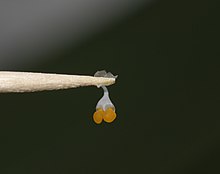
In orchids that produce pollinia, pollination happens every bit some variant of the following sequence: when the pollinator enters into the flower, information technology touches a viscidium, which promptly sticks to its body, generally on the head or abdomen. While leaving the flower, it pulls the pollinium out of the anther, as it is connected to the viscidium by the caudicle or stipe. The caudicle then bends and the pollinium is moved frontward and downwards. When the pollinator enters some other flower of the same species, the pollinium has taken such position that it will stick to the stigma of the second flower, just below the rostellum, pollinating it. In horticulture, bogus orchid pollination is achieved by removing the pollinia with a small musical instrument such as a toothpick from the pollen parent and transferring them to the seed parent.

Some orchids mainly or totally rely on cocky-pollination, specially in colder regions where pollinators are particularly rare. The caudicles may dry upwards if the flower has non been visited by whatever pollinator, and the pollinia then fall straight on the stigma. Otherwise, the anther may rotate and then enter the stigma cavity of the bloom (as in Holcoglossum amesianum).
The slipper orchid Paphiopedilum parishii reproduces by self-fertilization. This occurs when the anther changes from a solid to a liquid state and directly contacts the stigma surface without the help of any pollinating agent or floral assembly.[nine]
The labellum of the Cypripedioideae is poke bonnet-shaped, and has the function of trapping visiting insects. The only exit leads to the anthers that eolith pollen on the company.
In some extremely specialized orchids, such every bit the Eurasian genus Ophrys, the labellum is adjusted to have a color, shape, and smell which attracts male person insects via mimicry of a receptive female person. Pollination happens as the insect attempts to mate with flowers.
Many neotropical orchids are pollinated past male person orchid bees, which visit the flowers to get together volatile chemicals they crave to synthesize pheromonal attractants. Males of such species equally Euglossa imperialis or Eulaema meriana have been observed to get out their territories periodically to forage for aromatic compounds, such as cineole, to synthesize pheromone for attracting and mating with females.[10] [xi] Each type of orchid places the pollinia on a different body part of a different species of bee, and then as to enforce proper cantankerous-pollination.
A rare achlorophyllous saprophytic orchid growing entirely underground in Australia, Rhizanthella slateri, is never exposed to light, and depends on ants and other terrestrial insects to pollinate it.
Catasetum, a genus discussed briefly by Darwin, actually launches its viscous pollinia with explosive force when an insect touches a seta, knocking the pollinator off the flower.
Afterwards pollination, the sepals and petals fade and wilt, but they usually remain attached to the ovary.
Asexuality [edit]
Some species, such every bit in the genera Phalaenopsis, Dendrobium, and Vanda, produce offshoots or plantlets formed from one of the nodes forth the stem, through the accumulation of growth hormones at that betoken. These shoots are known as keiki.
Fruits and seeds [edit]
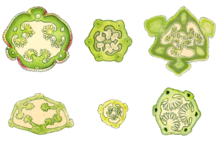
Cantankerous-sections of orchid capsules showing the longitudinal slits
The ovary typically develops into a sheathing that is dehiscent past three or six longitudinal slits, while remaining closed at both ends.
The seeds are by and large about microscopic and very numerous, in some species over a million per capsule. After ripening, they blow off similar dust particles or spores. Most orchid species lack endosperm in their seed and must enter symbiotic relationships with various mycorrhizal basidiomyceteous fungi that provide them the necessary nutrients to germinate, so near all orchid species are mycoheterotrophic during formation and reliant upon fungi to complete their lifecycles. Only a handful of orchid species have seed that can germinate without mycorrhiza, namely the species within the genus Disa with hydrochorous seeds.[12] [13]
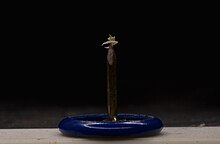
Orchid bulb (Disa uniflora) on a leaf of Sphagnum on a thumbtack
Every bit the take chances for a seed to run into a suitable fungus is very pocket-sized, but a infinitesimal fraction of all the seeds released grow into developed plants. In cultivation, germination typically takes weeks.
Horticultural techniques accept been devised for germinating orchid seeds on an artificial nutrient medium, eliminating the requirement of the fungus for germination and profoundly aiding the propagation of ornamental orchids. The usual medium for the sowing of orchids in artificial weather is agar gel combined with a carbohydrate energy source. The saccharide source can exist combinations of detached sugars or tin can be derived from other sources such as banana, pineapple, peach, or even tomato puree or coconut water. Afterwards the preparation of the agar medium, information technology is poured into exam tubes or jars which are then autoclaved (or cooked in a force per unit area cooker) to sterilize the medium. After cooking, the medium begins to gel as it cools.
Taxonomy [edit]
The taxonomy of this family unit is in constant flux, every bit new studies continue to clarify the relationships between species and groups of species, allowing more taxa at several ranks to be recognized. The Orchidaceae is currently placed in the order Asparagales by the APG Three organization of 2009.[one]
Five subfamilies are recognised. The cladogram below was made co-ordinate to the APG arrangement of 1998. It represents the view that well-nigh botanists had held up to that time. It was supported by morphological studies, just never received stiff support in molecular phylogenetic studies.
| |||||||||||||
In 2015, a phylogenetic study[14] showed strong statistical back up for the following topology of the orchid tree, using 9 kb of plastid and nuclear DNA from 7 genes, a topology that was confirmed by a phylogenomic written report in the same twelvemonth.[15]
Development [edit]
A report in the scientific journal Nature has hypothesised that the origin of orchids goes back much longer than originally expected.[16] An extinct species of stingless bee, Proplebeia dominicana, was found trapped in Miocene amber from almost 15-twenty 1000000 years agone. The bee was carrying pollen of a previously unknown orchid taxon, Meliorchis caribea, on its wings. This notice is the showtime evidence of fossilised orchids to engagement[xvi] and shows insects were active pollinators of orchids then. This extinct orchid, M. caribea, has been placed inside the extant tribe Cranichideae, subtribe Goodyerinae (subfamily Orchidoideae). An even older orchid species, Succinanthera baltica, was described from the Eocene Baltic amber by Poinar & Rasmussen (2017).[17]
Genetic sequencing indicates orchids may have arisen earlier, 76 to 84 million years ago during the Late Cretaceous.[18] Co-ordinate to Mark W. Chase et al. (2001), the overall biogeography and phylogenetic patterns of Orchidaceae show they are fifty-fifty older and may go dorsum roughly 100 million years.[nineteen]
Using the molecular clock method, information technology was possible to decide the age of the major branches of the orchid family. This as well confirmed that the subfamily Vanilloideae is a branch at the basal dichotomy of the monandrous orchids, and must have evolved very early in the evolution of the family unit. Since this subfamily occurs worldwide in tropical and subtropical regions, from tropical America to tropical Asia, New Guinea and W Africa, and the continents began to dissever about 100 million years agone, significant biotic exchange must have occurred after this split (since the age of Vanilla is estimated at 60 to lxx million years).
Genome duplication occurred prior to the deviation of this taxon.[xx]
Genera [edit]
There are effectually 800 genera of orchids. The following are amongst the nigh notable genera of the orchid family:[ citation needed ]
- Aa
- Abdominea
- Acampe
- Acanthophippium
- Aceratorchis
- Acianthus
- Acineta
- Acrorchis
- Ada
- Aerangis
- Aeranthes
- Aerides
- Aganisia
- Agrostophyllum
- Anacamptis
- Ancistrochilus
- Angraecum
- Anguloa
- Ansellia
- Aorchis
- Aplectrum
- Arachnis
- Arethusa
- Armodorum
- Ascocenda
- Ascocentrum
- Ascoglossum
- Australorchis
- Auxopus
- Baptistonia
- Barkeria
- Barlia
- Bartholina
- Beloglottis
- Biermannia
- Bletilla
- Brassavola
- Brassia
- Bulbophyllum
- Calanthe
- Calypso
- Catasetum
- Cattleya
- Chiloschista
- Cirrhopetalum
- Cleisostoma
- Clowesia
- Coelogyne
- Coryanthes
- Cycnoches
- Cymbidium
- Cyrtopodium
- Cypripedium
- Dactylorhiza
- Dendrobium
- Disa
- Dracula
- Encyclia
- Epidendrum
- Epipactis
- Eria
- Eulophia
- Gastrochilus
- Gongora
- Goodyera
- Grammatophyllum
- Gymnadenia
- Habenaria
- Herschelia
- Ionopsis
- Laelia
- Lepanthes
- Liparis
- Ludisia
- Lycaste
- Masdevallia
- Maxillaria
- Meliorchis
- Mexipedium
- Miltonia
- Mormodes
- Odontoglossum
- Oeceoclades
- Oncidium
- Ophrys
- Orchis
- Paphiopedilum
- Papilionanthe
- Paraphalaenopsis
- Peristeria
- Phaius
- Phalaenopsis
- Pholidota
- Phragmipedium
- Platanthera
- Platystele
- Pleione
- Pleurothallis
- Pomatocalpa
- Promenaea
- Pterostylis
- Renanthera
- Renantherella
- Restrepia
- Restrepiella
- Rhynchostylis
- Roezliella
- Saccolabium
- Sarcochilus
- Satyrium
- Seidenfadenia
- Selenipedium
- Serapias
- Sobralia
- Sophronitis
- Spiranthes
- Stanhopea
- Stelis
- Thrixspermum
- Tolumnia
- Trias
- Trichocentrum
- Trichoglottis
- Vanda
- Vanilla
- Yoania
- Zeuxine
- Zygopetalum
Etymology [edit]
The type genus (i.e. the genus afterwards which the family is named) is Orchis. The genus proper name comes from the Ancient Greek ὄρχις ( órkhis ), literally meaning "testicle", because of the shape of the twin tubers in some species of Orchis.[21] [22] The term "orchid" was introduced in 1845 by John Lindley in School Botany,[23] every bit a shortened course of Orchidaceae.[24]
In Middle English, the proper noun bollockwort was used for some orchids, based on "bollock" meaning testicle and "wort" meaning plant.[25]
Hybrids [edit]
Orchid species hybridize readily in cultivation, leading to a large number of hybrids with complex naming. Hybridization is possible across genera, and therefore many cultivated orchids are placed into nothogenera. For instance, the nothogenus Brassocattleya is used for all hybrids of species from the genera Brassavola and Cattleya. Nothogenera based on at to the lowest degree three genera may have names based on a person's name with the suffix -ara, for case Colmanara = Miltonia × Odontoglossum × Oncidium. (The suffix is obligatory starting at four genera.[26])
Cultivated hybrids in the orchid family are as well special in that they are named by using grex classification, rather than nothospecies. For instance, hybrids between Brassavola nodosa and Brassavola acaulis are placed in the grex Brassavola Guiseppi.[27] The proper name of the grex ("Guiseppi" in this instance) is written in a non-italic font without quotes.[28]
Abbreviations [edit]
As a unique feature of the orchid family, a organization of abbreviations exists that applies to names of genera and nothogenera. The system is maintained by the Purple Horticultural Society.[29] These abbreviations consist of at least i character, but may be longer. As opposed to the usual one-alphabetic character abbreviations used for names of genera, orchid abbreviations uniquely determine the (notho)genus. They are widely used in cultivation. Examples are Phal for Phalaenopsis, Five for Vanda and Cleis for Cleisostoma.
Distribution [edit]
Orchidaceae are cosmopolitan, occurring in almost every habitat autonomously from glaciers. The world's richest multifariousness of orchid genera and species is found in the tropics, but they are likewise found above the Arctic Circle, in southern Patagonia, and two species of Nematoceras on Macquarie Isle at 54° south.
The following list gives a rough overview of their distribution:[ commendation needed ]
- Oceania: 50 to 70 genera
- N America: 20 to 26 genera
- tropical America: 212 to 250 genera
- tropical Asia: 260 to 300 genera
- tropical Africa: 230 to 270 genera
- Europe and temperate Asia: 40 to 60 genera
Ecology [edit]
A majority of orchids are perennial epiphytes, which grow anchored to copse or shrubs in the torrid zone and subtropics. Species such every bit Angraecum sororium are lithophytes,[xxx] growing on rocks or very rocky soil. Other orchids (including the bulk of temperate Orchidaceae) are terrestrial and can exist found in habitat areas such every bit grasslands or forest.
Some orchids, such as Neottia and Corallorhiza, lack chlorophyll, so are unable to photosynthesise. Instead, these species obtain energy and nutrients by parasitising soil fungi through the formation of orchid mycorrhizae. The fungi involved include those that form ectomycorrhizas with trees and other woody plants, parasites such equally Armillaria, and saprotrophs.[31] These orchids are known as myco-heterotrophs, merely were formerly (incorrectly) described every bit saprophytes every bit it was believed they gained their nutrition by breaking downwardly organic matter. While simply a few species are achlorophyllous holoparasites, all orchids are myco-heterotrophic during formation and bulb growth, and even photosynthetic adult plants may keep to obtain carbon from their mycorrhizal fungi.
Uses [edit]
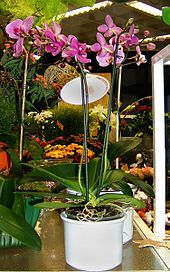
As ornament in a flowerpot
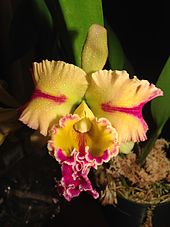
Perfumery [edit]
The scent of orchids is frequently analysed by perfumers (using headspace technology and gas-liquid chromatography/mass spectrometry) to place potential fragrance chemicals.[32]
Horticulture [edit]
The other important use of orchids is their cultivation for the enjoyment of the flowers. Most cultivated orchids are tropical or subtropical, simply quite a few that grow in colder climates can exist found on the marketplace. Temperate species available at nurseries include Ophrys apifera (bee orchid), Gymnadenia conopsea (fragrant orchid), Anacamptis pyramidalis (pyramidal orchid) and Dactylorhiza fuchsii (common spotted orchid).
Orchids of all types take also frequently been sought by collectors of both species and hybrids. Many hundreds of societies and clubs worldwide take been established. These tin be minor, local clubs, or larger, national organisations such every bit the American Orchid Guild. Both serve to encourage cultivation and collection of orchids, only some go further by concentrating on conservation or inquiry.
The term "botanical orchid" loosely denotes those small-scale-flowered, tropical orchids belonging to several genera that do not fit into the "florist" orchid category. A few of these genera contain enormous numbers of species. Some, such every bit Pleurothallis and Bulbophyllum, contain approximately 1700 and 2000 species, respectively, and are ofttimes extremely vegetatively diverse. The primary use of the term is among orchid hobbyists wishing to describe unusual species they abound, though it is also used to distinguish naturally occurring orchid species from horticulturally created hybrids.
New orchids are registered with the International Orchid Register, maintained by the Imperial Horticultural Society.[33]
Food [edit]
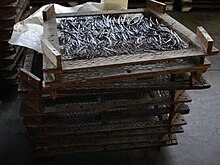
The dried seed pods of i orchid genus, Vanilla (especially Vanilla planifolia), are commercially important equally a flavouring in baking, for perfume manufacture and aromatherapy.
The underground tubers of terrestrial orchids [mainly Orchis mascula (early majestic orchid)] are ground to a powder and used for cooking, such as in the hot drink salep or in the Turkish mastic water ice cream dondurma. The proper name salep has been claimed to come up from the Arabic expression ḥasyu al-tha'lab , "pull a fast one on testicles", but it appears more probable the name comes directly from the Arabic name saḥlab . The similarity in advent to testes naturally accounts for salep being considered an aphrodisiac.
The stale leaves of Jumellea fragrans are used to flavor rum on Reunion Island.
Some saprophytic orchid species of the group Gastrodia produce potato-like tubers and were consumed as food by native peoples in Commonwealth of australia and can be successfully cultivated, notably Gastrodia sesamoides. Wild stands of these plants tin still be plant in the aforementioned areas equally early on Aboriginal settlements, such as Ku-ring-gai Chase National Park in Australia. Ancient peoples located the plants in habitat by observing where bandicoots had scratched in search of the tubers later on detecting the plants underground past olfactory property.[Annotation 1]
Cultural symbolism [edit]
Orchids have many associations with symbolic values. For example, the orchid is the City Flower of Shaoxing, China. Cattleya mossiae is the national Venezuelan blossom, while Cattleya trianae is the national bloom of Republic of colombia. Vanda Miss Joaquim is the national flower of Singapore, Guarianthe skinneri is the national blossom of Republic of costa rica and Rhyncholaelia digbyana is the national flower of Honduras.[35] Prosthechea cochleata is the national flower of Belize, where it is known every bit the black orchid.[36] Lycaste skinneri has a white variety (alba) that is the national blossom of Guatemala, normally known as Monja Blanca (White Nun). Panama's national flower is the Holy Ghost orchid (Peristeria elata), or 'the flor del Espiritu Santo'. Rhynchostylis retusa is the state blossom of the Indian state of Assam where it is known equally Kopou Phul. [37]
Orchids native to the Mediterranean are depicted on the Ara Pacis in Rome, until now the only known instance of orchids in ancient fine art, and the earliest in European art.[Note two]
- Some cultivars
-

Cattleya Mrs. Mahler 'Mem. Fred Tompkins'
-

Cattleya Queen Sirikit 'Diamond Crown'
-
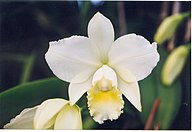
Cattleya Hawaiian Wedding ceremony Song 'Virgin'
-
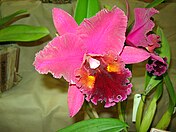
Rhyncholaeliocattleya Chia Lin
-

Cattleya Hawaiian Variable 'Prasan'
-
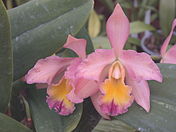
Cattlianthe Barbara Belle
-
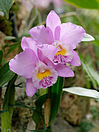
Cattleya Beaumesnil 'Parme'
-
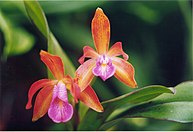
Cattlianthe Chocolate Drop x Cattleya Pão de Açúcar
-
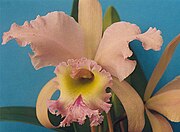
'Hermine'
-
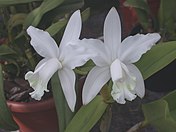
Cattleya Piffling Angel
-

Cattleya Marjorie Hausermann 'York'
-

'Miva Breeze Alize'
-
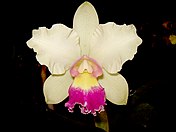
Rhyncholaeliocattleya 'Nobile's carnival'
-

Cattleya Pernel George Barnett 'Yankee Clipper'
-
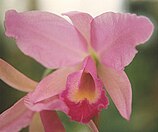
Cattlianthe Portia
Conservation [edit]
Most all orchids are included in Appendix II of the Convention on International Trade in Endangered Species (CITES), meaning that international trade (including in their parts/derivatives) is regulated by the CITES permit system.[39] A smaller number of orchids such equally Paphiopedilum sp. are listed in CITES Appendix I meaning that commercial international trade in wild-sourced specimens is prohibited and all other trade is strictly controlled.[39]
Run into also [edit]
- Adaptation (film), based on The Orchid Thief
- Distribution of orchid species
- Italian Group for Inquiry on Wild Orchid
- Orchid Conservation Coalition
- Orchid Pavilion Gathering
- Orchidelirium, the Victorian era of flower madness in which collecting and discovering orchids reached extraordinary levels
- Orchids of the Philippines
- Orchids of Western Australia
- Shangsi Festival
Notes [edit]
- ^ Early on western district (Vic.) settler gives business relationship of local Aboriginal people gathering murphy orchid tubers, excavation where bandicoots had scratched.[34]
- ^ The symbolic (or even religious) pregnant of the Ara Pacis orchids is not still known.[38]
References [edit]
- ^ a b Flowering plant Phylogeny Grouping (2009). "An update of the Angiosperm Phylogeny Group classification for the orders and families of flowering plants: APG 3". Botanical Periodical of the Linnean Society. 161 (2): 105–121. doi:x.1111/j.1095-8339.2009.00996.ten.
- ^ Christenhusz, Thou. J. M. & Byng, J. W. (2016). "The number of known plants species in the world and its annual increase". Phytotaxa. 261 (three): 201–217. doi:ten.11646/phytotaxa.261.3.ane.
- ^ "WCSP". World Checklist of Selected Plant Families . Retrieved ii April 2010. (Run into External links below).
- ^ Yohan Pillon & Mark Due west. Chase (2007). "Taxonomic exaggeration and its effects on orchid conservation". Conservation Biology. 21 (1): 263–265. doi:ten.1111/j.1523-1739.2006.00573.10. PMID 17298532.
- ^ Nash, Due north., and Frownie, South. (2008). Consummate guide to orchids. (Meredith Publishing Group) p. 12.
- ^ Jenny King (10 June 2011). "The coralroot orchid". Orchids in Northern Washington State. Silvercrown Mountain Outdoor School. Retrieved 10 June 2011.
- ^ Tom Lawrie (23 November 2010). "World's first nighttime-flowering orchid discovered". Australian Geographic. Archived from the original on xxx November 2011. Retrieved 26 May 2013.
- ^ Tan K.H.; Nishida R. (2000). "Mutual reproductive benefits between a wild orchid, Bulbophyllum patens, and Bactrocera fruit flies via a floral synomone". Periodical of Chemical Ecology. 26 (two): 533–546. doi:10.1023/A:1005477926244. S2CID 24971928. , 28:1161-1172 and 31(3): 509-519.
- ^ Chen LJ, Liu KW, Xiao XJ, Tsai WC, Hsiao YY, Huang J, Liu ZJ (2012). "The anther steps onto the stigma for cocky-fertilization in a slipper orchid". PLOS 1. 7 (five): e37478. Bibcode:2012PLoSO...737478C. doi:10.1371/periodical.pone.0037478. PMC3359306. PMID 22649529.
- ^ Kimsey Lynn Siri (1980). "The behaviour of male person orchid bees (Apidae, Hymenoptera, Insecta) and the question of leks". Animal Behaviour. 28 (4): 996–1004. doi:10.1016/s0003-3472(80)80088-ane. S2CID 53161684.
- ^ Zimmermann, Yvonne; Roubik, David W.; Eltz, Thomas (xix July 2006). "Species-specific attraction to pheromonal analogues in orchid bees". Behavioral Ecology and Sociobiology. 60 (vi): 833–843. doi:10.1007/s00265-006-0227-8. ISSN 0340-5443. S2CID 20819411.
- ^ Thompson, David Ian (2003). Conservation of select South African Disa Berg. Species (Orchidaceae) through in vitro seed germination. Academy of Natal.
- ^ Kurzweil, H. (September 1993). "Seed morphology in Southern African Orchidoideae (Orchidaceae)". Plant Systematics and Evolution. 185 (3–four): 229–247. doi:10.1007/BF00937660. S2CID 41321812.
- ^ Guillaume Chomicki; Luc P.R. Bidel; Feng Ming; Mario Coiro; Xuan Zhang; Yaofeng Wang; Yves Baissac; Christian Jay-Allemand & Susanne South. Renner (2015). "The velamen protects photosynthetic orchid roots confronting UV‐B impairment, and a big dated phylogeny implies multiple gains and losses of this function during the Cenozoic". New Phytologist. 205 (three): 1330–1341. doi:10.1111/nph.13106. PMID 25345817.
- ^ Givnish, Thomas J.; Spalink, Daniel; Ames, Mercedes; Lyon, Stephanie P.; Hunter, Steven J.; Zuluaga, Alejandro; Iles, William J.D.; Clements, Mark A.; Arroyo, Mary T.K.; Leebens-Mack, James; Endara, Lorena; Kriebel, Ricardo; Neubig, Kurt Thou.; Whitten, Westward. Mark; Williams, Norris H.; Cameron, Kenneth M. (2015). "Orchid phylogenomics and multiple drivers of their extraordinary diversification". Proceedings of the Royal Guild B: Biological Sciences. 282 (1814): 20151553. doi:10.1098/rspb.2015.1553. PMC4571710. PMID 26311671.
- ^ a b Santiago R. Ramírez; Barbara Gravendeel; Rodrigo B. Vocalist; Charles R. Marshall; Naomi E. Pierce (thirty Baronial 2007). "Dating the origin of the Orchidaceae from a fossil orchid with its pollinator". Nature. 448 (7157): 1042–5. Bibcode:2007Natur.448.1042R. doi:10.1038/nature06039. PMID 17728756. S2CID 4402181.
- ^ George Poinar, Jr.; Finn N. Rasmussen (2017). "Orchids from the past, with a new species in Baltic amber". Botanical Journal of the Linnean Society. 183 (3): 327–333. doi:10.1093/botlinnean/bow018.
- ^ "An overview of the Phalaenopsis orchid genome by BAC sequence assay" (pdf format).
- ^ Marker W. Chase (2001). "The origin and biogeography of Orchidaceae". In A. Chiliad. Pridgeon; P. J. Cribb; M. W. Chase; F. Rasmussen (eds.). Orchidoideae (Office 1). Genera Orchidacearum. Vol. 2. Oxford Academy Press. pp. 1–5. ISBN978-0-19-850710-9.
- ^ Zhang, Guo-Qiang; Liu, Ke-Wei; Li, Zhen; Lohaus, Rolf; Hsiao, Yu-Yun; Niu, Shan-Ce; Wang, Jie-Yu; Lin, Yao-Cheng; Xu, Qing; Chen, Li-Jun; Yoshida, Kouki; Fujiwara, Sumire; Wang, Zhi-Wen; Zhang, Yong-Qiang; Mitsuda, Nobutaka; Wang, Meina; Liu, Guo-Hui; Pecoraro, Lorenzo; Huang, Hui-Xia; Xiao, Xin-Ju; Lin, Min; Wu, Xin-Yi; Wu, Wan-Lin; Chen, Y'all-Yi; Chang, Song-Bin; Sakamoto, Shingo; Ohme-Takagi, Masaru; Yagi, Masafumi; Zeng, Si-Jin; et al. (2017). "The Apostasia genome and the development of orchids" (PDF). Nature. 549 (7672): 379–383. Bibcode:2017Natur.549..379Z. doi:10.1038/nature23897. PMC7416622. PMID 28902843.
- ^ Joan Corominas (1980). Breve Diccionario Etimológico de la Lengua Castellana . Ed. Gredos. p. 328. ISBN978-84-249-1332-8.
- ^ Hyam, R. & Pankhurst, R.J. (1995). Plants and their names : a concise dictionary. Oxford: Oxford University Printing. ISBN978-0-19-866189-4.
- ^ Online Etymology Dictionary, "orchid".
- ^ Grigson, G. (1973). A Dictionary of English Found Names. London: Allen Lane. ISBN978-0-7139-0442-0.
- ^ "bollock, northward. and adj". Oxford English Dictionary . Retrieved 19 Jan 2018.
- ^ International Code of Nomenclature for Cultivated Plants ninth edition (2016), Article H.six and H.vii.
- ^ Brassavola Guiseppi Casa Luna 1968, BlueNanta.
- ^ International Lawmaking of Classification for Cultivated Plants 9th edition, 2016.
- ^ "Alphabetical List of Standard Abbreviations for Natural and Hybrid Generic Names" (PDF).
- ^ Melissa Whitman; Michael Medler; Jean Jacques Randriamanindry; Elisabeth Rabakonandrianina (2011). "Conservation of Madagascar'south granite outcrop orchids: influence of fire and wet" (PDF). Lankesteriana. 11 (1): 55–67. doi:10.15517/lank.v11i1.18315.
- ^ Jonathan R. Leake (2005). "Plants parasitic on fungi: unearthing the fungi in myco-heterotrophs and debunking the 'saprophytic' plant myth". Mycologist. 19 (3): 113–122. doi:ten.1017/S0269915X05003046.
- ^ Gross, K.; Dominicus, M; Schiestl, F. P. (2016). "Why Exercise Floral Perfumes Go Dissimilar? Region-Specific Option on Floral Scent in a Terrestrial Orchid". PLOS One. eleven (ii): e0147975. Bibcode:2016PLoSO..1147975G. doi:10.1371/periodical.pone.0147975. PMC4757410. PMID 26886766.
- ^ RHS 2016.
- ^ Zola, Nellie; Gott, Beth (1992). Koorie Plants, Koorie People: Traditional Aboriginal Nutrient, Fibre and Healing Plants of Victoria. Koorie Heritage Trust Incorporated. p. 38. ISBN978-1-875606-10-viii.
- ^ "Simbolos Patrios" (in Castilian). Retrieved 22 June 2008.
- ^ "National Symbols". Government of Belize. Archived from the original on 12 October 2007. Retrieved 6 April 2008.
- ^ admin (ane March 2012). "List of Assam State Symbols | State Animal| State Flower | Land Tree". assamyellowpage.com . Retrieved 14 May 2019.
- ^ Jarrett A. Lobelli (2012). "The Emperor's orchids". Archeology. 66 (1): sixteen. Archived from the original on 17 December 2012.
- ^ a b The CITES Appendices, CITES, archived from the original on xiv April 2012, retrieved xvi Apr 2012
Bibliography [edit]
- RHS (2016). "Search The International Orchid Register". Royal Horticultural Order. Retrieved 28 November 2017.
External links [edit]
- Orchidaceae observations at iNaturalist
- Orchidaceae at The Plant List
- Orchidaceae at the Angiosperm Phylogeny Website
- World checklist of Orchidaceae species from the Catalogue of Life, 29,572 species supplied past World Checklist of Selected Plant Families (R. Govaerts & al.)
- Orchidaceae at the online Flora of N America
- Orchidaceae at the online Flora of China
- Orchidaceae at the online Flora of Republic of zimbabwe
- Orchidaceae at the online Flora of the Western Australian
- Orchidaceae at the online Flora of New Zealand
- The Global Orchid Data Network
- Orchid Conservation Coalition
hamiltonainal1983.blogspot.com
Source: https://en.wikipedia.org/wiki/Orchidaceae
0 Response to "Orchid Kingdom Phylum Class Order Family Genus Species"
Postar um comentário