Random Sounds Over and Over Again
Semantic Satiation: Why Does A Word Sound Weird When Repeated Multiple Times?
Updated on: 17 Jan 2022 past Ashish
"'Diction'. What a smashing give-and-take that is, right? 'Diction'. I recollect the word is so slick that I like to say information technology over and over once again.
This guy has great wording.
You should really work on your diction.
Diction is all nigh choosing the correct words in the right places.
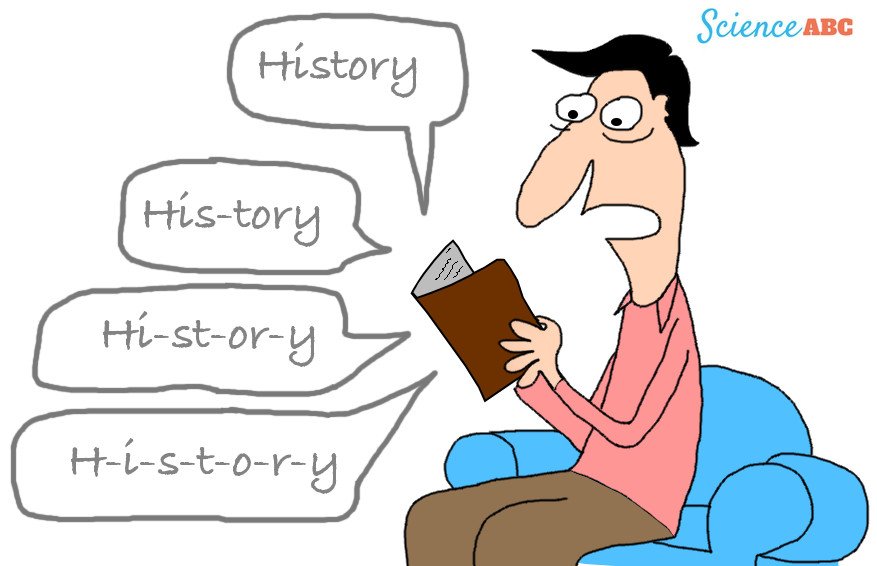
Diction. Hmm.. diction… d-i-c-t-i-o-northward… diction… di– wait a minute, why does the word sound so weird now?"
Does this situation sound familiar? Has it ever happened to y'all that a perfectly normal word, when repeated over and over and over over again, suddenly loses all its meaning and starts sounding weird? This includes both prolonged viewing of the word and its agile repetition (oral or written).
If this has happened with you lot, then let me tell y'all this:
This miracle (namely when a word loses all its meaning when repeated multiple times), in fact, is quite common, and it as well has a fancy name: semantic satiation.
Recommended Video for you:
What is semantic satiation?
Semantic satiation is the name of a psychological miracle wherein the repetition of a word, whether it'south visual or oral, causes it to lose its meaning for the viewer/listener, and makes it seem like it's just a meaningless sound. Historically, the term 'semantic satiation' has been used to refer to the subjective loss of significant that comes every bit a result of prolonged exposure to a word.
The term 'semantic satiation' was coined by Leon Jakobovits James (a psychology professor at the University of Hawaii) in his 1962 doctoral dissertation at McGill University; he wrote his doctoral thesis on the phenomenon. Co-ordinate to James, it'south a kind of fatigue (reactive inhibition). He says, "when a brain prison cell fires, it takes more energy to fire the second time, and withal more than the third time, and finally the fourth fourth dimension, information technology won't fifty-fifty respond unless you lot wait a few seconds." He adds that the more times you lot echo a word, the more free energy it takes.
Although, you tin can experience semantic satiation with practically every discussion, some words lose significant faster than others. These are usually the words with whom you take "stronger associations". For instance, the word "Internet" would plow into brain mush far less quickly than the word "semantic".
Semantic satiation tin be experienced with whatever word.
But why does actually happen? What'south going on hither?
Reason behind semantic satiation
When y'all hear, read or speak a discussion, your brain isn't really listening to its sound; rather, it'due south translating those sounds into an idea. That thought is and so put together with other words, to form a more complex idea. Withal, when you repeat a word multiple times, your brain ceases to recognize it as a word (which subsequently keeps it from translating it into an idea), and breaks it down into sounds. These sounds, of class, have nada to do with the inherent meaning of the word. That's why a purely normal word begins to sound like gibberish.
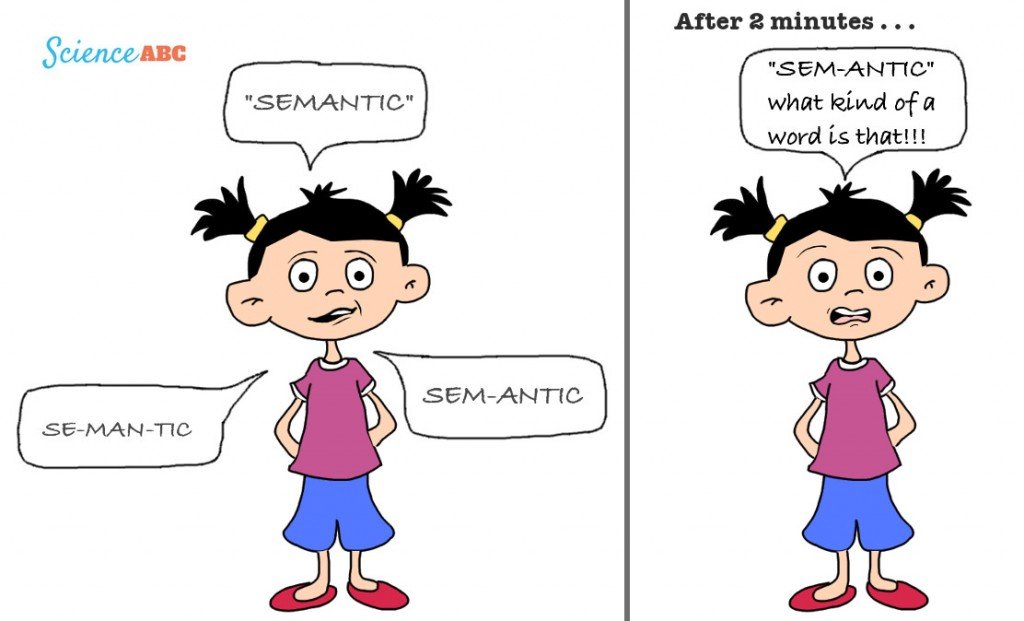
The longer a word is 'played' with, the more meaningless it becomes.
Call back of it this way: our brains have an incredible ability to take words and understand an unabridged concept associated with them. For instance, when you call back of the word "book", you instantly conjure up the image of a book. Yous may take additional details similar color, thickness, cover etc. in the background, just you instantly connect with the idea of a book the moment you look at the discussion or hear/speak it.
However, when you start repeating information technology actively, the encephalon refocuses on the bodily word "book". So, it thinks virtually the give-and-take, its intonation, sound, the letters it comprises etc. These things obviously take nil to do with the idea of a book, which is why the word seems meaningless the more times it'south repeated.
Interestingly, the idea of semantic satiation is used to develop techniques to reduce speech anxiety by stutterers. The repetition of specific words leads to semantic satiation, which, in turn, leads to a reduction in the intensity of negative memories and emotions that are triggered while speaking.
Did y'all ever imagine that something you considered a random 'thing' with words could actually be used to help patients with oral communication defects?
I doubt it. Doubt it. Doubt… dubiousness… d-o-u-b-t…
Help us make this commodity better
Share this mail on Social Media:
Follow ScienceABC on Social Media:
Well-nigh the Writer
Ashish is a Scientific discipline graduate (Bachelor of Science) from Punjabi University (India). He spends a lot of time watching movies, and an atrocious lot more time discussing them. He likes Harry Potter and the Avengers, and obsesses over how thoroughly Scientific discipline dictates every aspect of life… in this universe, at least.
.
Scientific discipline ABC YouTube Videos
-
 How Do Neurons Piece of work?
 -
 How Scientifically Accurate Is The HBO Miniseries Chernobyl?
 -
 Cellular Respiration: How Do Cell Get Energy?
 -
 Multiverse Theory Explained: Does the Multiverse Actually Exist? Truth of Multiple Realities
 -
 What Exactly is Spacetime? Explained in Ridiculously Simple Words
 -
 What Are The Unlike Atomic Models? Dalton, Rutherford, Bohr and Heisenberg Models Explained
 -
 Why Is Claret Drawn From Veins And Non From Arteries?
 -
 Emotions and the Brain: What is the limbic organisation?
hamiltonainal1983.blogspot.com
Source: https://www.scienceabc.com/eyeopeners/semantic-satiation-why-does-a-word-sound-weird-when-repeated-multiple-times.html
0 Response to "Random Sounds Over and Over Again"
Postar um comentário