What Happens if You Get Do Well on the Writing but Not the Reading in the Sat
Everything you need to know most the SAT Reading Section
What's Covered in the Reading Department?
The Sabbatum contains 4 sections, the first of which will always be reading. The Sat reading department is the longest function of the test, coming in at 65 minutes and 52 The SAT contains 4 sections, the first of which will always be reading. This department will test your disquisitional thinking and reading skills. The SAT reading section is the longest function of the test, coming in at 65 minutes and 52 questions. At that place are 5 sets of passages, all in English, and they include one set of paired passages with 10-11 questions each. Passage topics covered more often than not include fiction, social science, history, and scientific discipline, and while the exact order of the passages vary, you can always look a fiction passage to come up first. The given passages are written for a high school reading level. Students who don't bask reading books in their free time or have trouble with reading comprehension in school may get nervous at the prospect of answering so many questions in such a brusk amount of fourth dimension and will request online SAT Tutoring. Familiarizing yourself with the structure of the section and practicing reading strategies, however, can assistance you better your score.
Fiction
Fiction passages will e'er be the offset SAT reading passage y'all see, and you'll only see one of these passages per reading section. Commonly, the fiction passage is an extract from a longer story. You may find the fiction passage to be relatively easier than other passages considering passages tend to have been written somewhat recently and the language is relatively simple. With these passages, make sure tocontinue track of the characters in the story, and the main events in the plot.
History
History passages are usually 18th to 20th century main source documents, which provide first-mitt testimony to an issue or commentary on an idea. This type of passage can exist excerpts from a speech, a political essay, or a published editorial. These passages tin be hard to understand because of the writing may exist hundreds of years one-time and include outdated vocab. Expect to see passages titled "Vindication on the Rights of Women" or "Essay on Slavery and Abolitionism". With these passages, it'due south particularly of import that y'all read the blurb prior to the passage so you know who is speaking and figure out what the viewpoint of the passage will be. The speaker will often be a prominent person from history, such equally a civil rights activist or politico, pregnant you may already know how they feel nigh the topic existence discussed. History passages are unremarkably used in paired passages.
Science
Scientific discipline passages cover topics including chemistry, biology, or physics. Oft students detect these types of passages difficult because of the dense scientific jargon. Notwithstanding, what's nice about science passages is they usually follow a pretty similar format across tests. When answering these passages, try to keep runway ofwhat question the scientists are asking, what they hypothesize, what method they follow to examination their question, and what conclusion they brand.Science passages are also a mutual choice for paired passages.
Social Science
Social science passages cover topics including politics, economics, and anything similar. While these types of passages may audio like to the content covered in history passages, what's unlike about social science passages is that they by and large cover social studies topics or an experiment just like science passages do. For these passages, try to come across if you lot canfind a structure of a question, hypothesis, method, and conclusion, but like you would with a science passage.
Paired Passages
Paired passages are a set of two related passages. A set of paired passages will simply show upward once on the exam. These passages are starting time followed past questions request about each passage, and then questions asking you to compare the ideas discussed in the two passages. The verbal topic of paired passages varies, but you tin expect to run across either a gear up of science or history passages. For paired passages, a good tip is toread the first passage and answer the corresponding questions, and so the second passage and its corresponding questions.Finally, answer the questions that involve both passages. Doing the passages and questions in this order, every bit opposed to reading the ii passages together and doing all the questions, prevents you from getting overwhelmed past text and makes it easier to recall what each passage is discussing.
What Types of Questions Can I Await?
Once you start to take a lot of Saturday practice tests and reading sections, y'all'll realize that the College Board includes the aforementioned types of questions—in essence, only the specific passages will really differ. It's important to be familiar with these types of questions so yous can ready finer. For instance, if you are consistently getting master idea questions wrong, you lot tin target that area for practise and learn specific examination-taking strategies to amend on those questions.
Master Idea
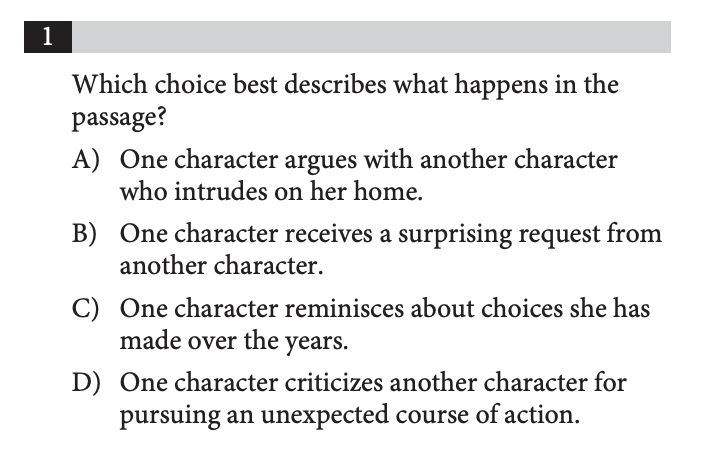
Main Idea questions are often 1 of the first questions that evidence upward after a passage ends. These questions enquire for the purpose of the passage or a specific paragraph, or they ask for how the focus of a passage shifts. Main thought questions require you to understand a general thought of what happened in the entire passage, as well as the point the author is trying to convey.
Vocabulary in Context
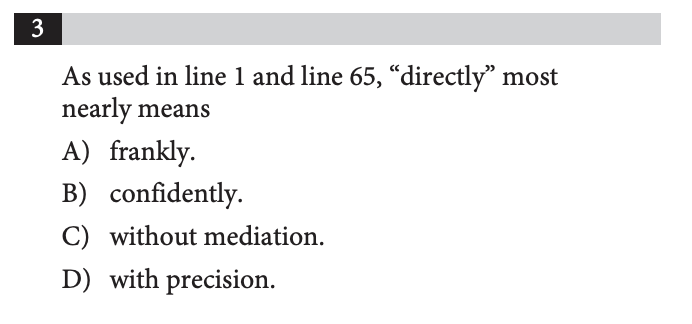
Vocabulary in context questions enquire you to define a word from the passage. The keyword here is "context." The Sat loves to selection words that take many definitions, and so make certain to take into account how the word is used in the passage. This means you'll take to get back to the text for context in gild to detect the correct answer.
Evidence-based
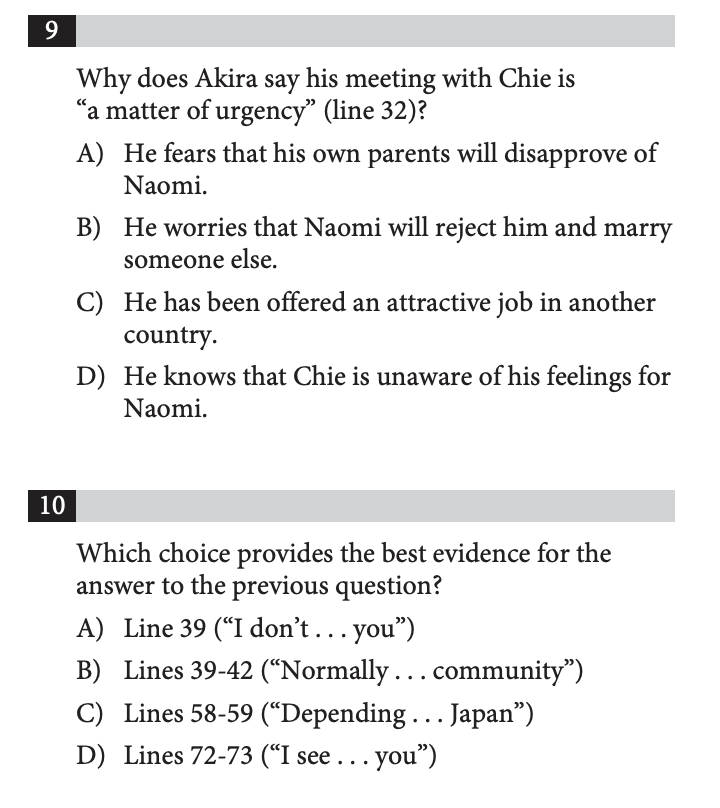
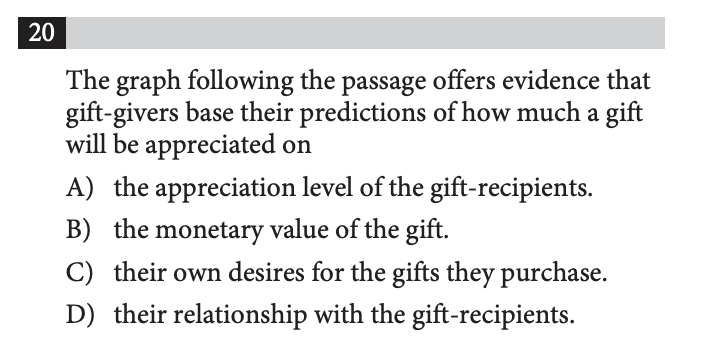
Evidence-based Questions are perhaps the most well-known (and most disliked) question type on the Saturday reading test. These questions come in a set of two: ane detail question, and one question asking you to pick a gear up of line numbers that provide testify to the previous question. The best fashion to handle these questions is to do them in contrary order (find a line number that answers the first detail question, so answer the item question).
Graphs
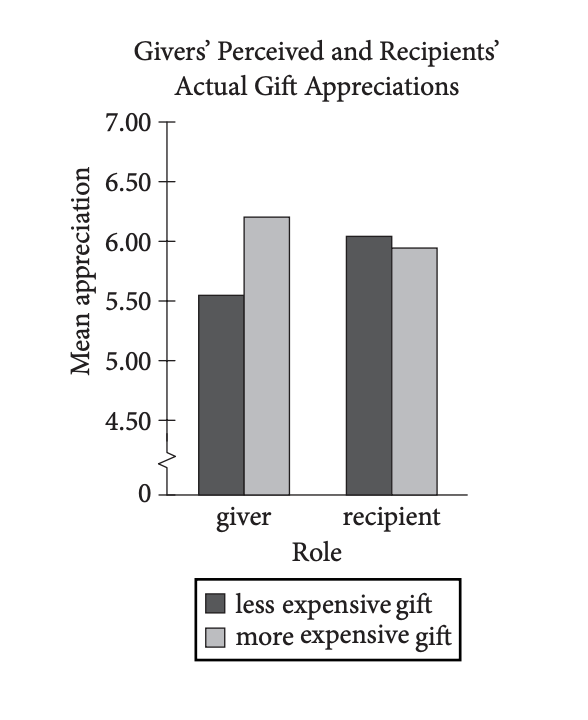
Graph questions are the to the lowest degree frequent question on the test. Usually, one or 2 Graph questions are the least frequent question on the test. Commonly, ane or two passages in the section will include a graph. Passages that feature a graph typically include 1 to two questions that examination your understanding of the graph. For students who don't like reading, yous're in luck, considering oftentimes these questions don't crave yous to have a practiced understanding of what happened in the passage. For these types of questions, you lot want to make sure to read the title and axis on the chart and place what main trend the graph is trying to convey. Make sure whichever answer choice you pick is consistent with the information in the graph.
Particular
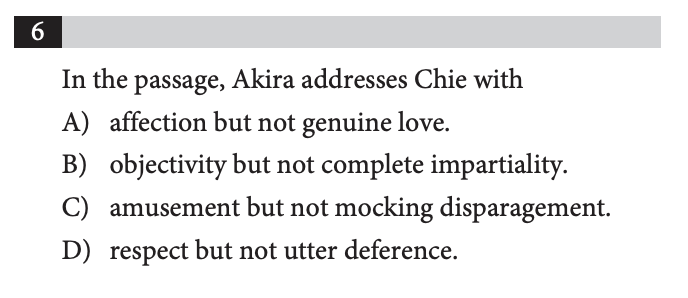
Detail questions include just about every other question type covered in the section. These questions can embrace anything else in the passage, and will usually ask you to remember specific events from the passage. Generally, these questions volition include a line number, so make certain to go dorsum into the text to find/underline supporting evidence rather than relying on your ain retentivity.
How Can I Improve My Saturday Reading Score?
The best manner to improve your score is to use these Saturday reading tips and strategies as you prepare for the test:
#ane: Practise Timed Passages At Dwelling house
While you may accept 65 minutes to consummate the reading section, many students find themselves running out of fourth dimension on this department similar to the ACT Reading Department. In gild to prepare for test 24-hour interval, doing reading sections in Sat practice tests under the time limit at home can assistance y'all get accustomed to the amount of time you'll have on exam day. Fifty-fifty though there are 65 minutes for the entire section, with 5 sets of passages, that breaks downward to about 13 minutes per passage set. Fifty-fifty if you are a fast reader, that's non a lot of time! Challenge yourself to spend no more than xiii minutes reading a passage and then answering the associated questions. Do as much reading do questions as yous can to become the timing downwards and have enough time to answer all the questions!
#ii: Don't Make Any Inferences (Unless Asked)
One of the biggest mistakes students can brand on the test is to bring in outside knowledge to the reading section or get-go using information that isn't part of the passage as evidence. The inference questions may seem challenging, just the correct answer will ever be entirely supported with testify from the passage. Never utilise your own opinion or background knowledge as a reason to pick an reply choice. The SAT isn't asking for your opinions, and your groundwork knowledge may be wrong. Occasionally a question will explicitly ask yous to make an inference, or what the author is implying. In these cases, any answer choice you lot pick should still be supported by textual show.
#3: Practice testify-based reading questions in reverse lodge
Students frequently find these questions challenging considering they retrieve if they selection a wrong answer to the first question, it automatically causes them to get the second question wrong. Information technology doesn't demand to be that way! The best way to tackle these questions is to do the second question start. That's right, get out of lodge! Read the detailed question first, and so read through all the line numbers in the second question. After y'all've establish a line number that answers the beginning particular question, go back to the first question and match whichever respond pick all-time corresponds with the line number you picked. Working out of order in this way ensures that y'all don't misremember a detail from the passage.
#iv: Do chief thought questions last
If yous had problem understanding a passage, principal thought questions are best saved for last. This means you should skip the main thought question until you lot answer all the detailed questions. Answering the detailed questions offset will help you get a better grasp of what happened in the passage and brand you more prepared to choose the correct reply to the main idea question.
#five: Use the whole sentence for a vocabulary in context question
The test makers will ever include a line number in vocabulary in context questions, then before taking a look at the reply choices, get back to the line number and re-read the judgement that includes the vocabulary discussion. Challenge yourself to come up up with a synonym for the discussion every bit it's used. So, go back to the answer choices and meet which choice best matches your synonym. Answering the question this way helps foreclose y'all from getting confused nigh the truthful definition of the discussion and stuck between the answer choices.
#vi: Read the blurb before the passage
Earlier every passage in the reading section, there will be a small blurb with information for the reader. These blurbs may explain the main characters in a story, or give y'all context for who wrote a passage and when. For example, if I know a passage is an excerpt from a speech given by an American president, I tin safely assume the passage volition talk about America, and probable be pro-America, even if I tin can't figure out annihilation else. This data is helpful in figuring out what a passage is about and its purpose.
#7: Expect out for misleading reply choices
If you see an answer choice with words like "always," "never," or "must," by and large that answer choice will be wrong. While a character may act a certain way in a passage, to say that they e'er deed like that would exist misleading considering we merely don't have that data. We're limited to the information presented in a passage, and nosotros tin can't make a comment on annihilation outside the passage.
#8: Pay attention to keywords
Keep an middle out for keywords in the passage that may help you figure out the main idea. Phrases forth the lines of "I believe" and "I hypothesize" can tell yous what the narrator is thinking. Other phrases like "evidence shows," "research suggests," or "nosotros demonstrated" tin tell you the conclusion of an experiment. You should also watch out for transition words. Transition words like "nevertheless" can bespeak you to a narrator's contrasting ideas, whereas words and phrases similar "therefore" or "for example" tin assistance yous figure out the path of a narrator's thoughts.
#9: Skim the passage
Many questions on the Sabbatum tin can be answered without fully reading the passage, or agreement it. About half of the questions on the section have line numbers that you can refer to. This means if y'all're running out of time at the end of a section, instead of reading the passage in its entirety, skim to get a general idea and relieve yourself some time.
#10: Don't allow yourself get stuck
The reading section is the longest department of the Saturday. You inevitably will accept to deal with a passage you don't empathise or reply a question y'all have difficulty with. With such trivial time to waste, and and then much content to get through, if you lot find yourself spending besides much time on a question or dislocated most part of your passage it'due south in your best interest to skip it and keep moving. All questions have the same value, and skipping one question won't hurt your score every bit much equally having less time to reply questions you have a better chance of getting right.
#xi: Observe the all-time annotating strategy for you
Figuring out the best annotating strategy can be helpful in both managing your time and understanding the passage. Annotating while you lot read means marker upwardly the passage and writing notes in the margins. This tin can be useful for improving overall reading comprehension, since you are more actively engaged in the passage. Annotating tin as well work as signposts for when yous refer back to the passage when you reply a question. You can use unlike annotating strategies for different types of passages: for case, for fiction passages a great fashion to annotate is to underline/circle graphic symbol names, the setting, and major plot points. Endeavour out different strategies and see what works for you, as everyone'due south reading skills differ.
Learn More About the SAT Reading Section With Help From SoFlo
SoFlo Sabbatum Tutors have experienced examination takers who are here to assist yous succeed. Our examination prep services offer i-on-one tutoring, where your SoFlo tutor tin help you identify and improve your individual weaknesses, non only on the reading section, but on the entire exam. SoFlo tutors can help you reach your goals, whether it be to reach a scholarship cutoff or to get that perfect score.
hamiltonainal1983.blogspot.com
Source: https://soflotutors.com/blog/sat-reading-prep/
0 Response to "What Happens if You Get Do Well on the Writing but Not the Reading in the Sat"
Postar um comentário