Where Was Reading Lolita in Tehran Published
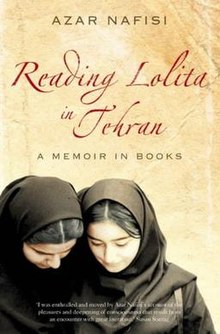
Reading Lolita in Tehran: A Memoir in Books is a book by Iranian writer and professor Azar Nafisi. Published in 2003, it was on the New York Times bestseller listing for over one hundred weeks and has been translated into 32 languages[1] [2]
Plot [edit]
The book consists of a memoir of the author'southward experiences about returning to Islamic republic of iran during the revolution (1978–1981) and living under the Islamic republic of iran government until her departure in 1997. Information technology narrates her didactics at the Academy of Tehran afterwards 1979, her refusal to submit to the rule to clothing the veil and her subsequent expulsion from the University, life during the Islamic republic of iran–Republic of iraq War, her return to teaching at the Academy of Allameh Tabatabei (1981), her resignation (1987), the formation of her book club (1995–97), and her conclusion to emigrate. Events are interlaced with the stories of book club members consisting of seven of her female students who met weekly at Nafisi's firm to discuss works of Western literature,[3] including the controversial Lolita, and the texts are interpreted through the books they read.
Construction [edit]
The book is divided into four sections: "Lolita", "Gatsby", "James", and "Austen".
"Lolita" deals with Nafisi as she resigns from The University of Allameh Tabatabei and starts her individual literature form with students Mahshid, Yassi, Mitra, Nassrin, Azin, Sanaz and Manna. They talk non just almost Lolita, just 1 K and 1 Nights and Invitation to a Beheading. The main themes are oppression, jailers equally revolutionary guards effort to assert their dominance through certain events such as a vacation gone awry and a delinquent captive.
"Gatsby" is prepare near eleven years before "Lolita" just as the Iranian revolution starts. The reader learns how some Iranians' dreams, including the writer's, became shattered through the government'due south imposition of new rules. Nafisi's student Mr. Nyazi puts the novel on trial, challenge that it condones adultery. Chronologically this is the kickoff part of Nafisi'south story. The Keen Gatsby and Mike Golden'southward works are discussed in this part. The reader meets Nassrin.
Nafisi states that the Gatsby chapter is about the American dream, the Iranian dream of revolution and the fashion it was shattered for her; the James affiliate is virtually incertitude and the way totalitarian mindsets hate incertitude; and Austen is well-nigh the option of women, a adult female at the heart of the novel saying no to the authorisation of her parents, order, and welcoming a life of dire poverty in gild to brand her ain choice.
"James" takes identify right later on "Gatsby", when the Iran–Iraq War begins and Nafisi is expelled from the University of Tehran along with a few other professors. The veil becomes mandatory and she states that the government wants to control the liberal-minded professors. Nafisi meets the man she calls her "magician", seemingly a literary academician who had retired from public life at the fourth dimension of the revolution. Daisy Miller and Washington Square are the main texts. Nassrin reappears after spending several years in prison.
"Austen" succeeds "Lolita" equally Nafisi plans to leave Iran and the girls talk over the issue of marriages, men and sex activity. The simply existent flashback (not counting historical background) is into how the girls and Nafisi toyed with the thought of creating a Beloved Jane society. While Azin deals with an abusive husband and Nassrin plans to leave for England, Nafisi's magician reminds her not to blame all of her issues on the Islamic Republic. Pride and Prejudice, while the primary focus, is used more to reinforce themes nigh blindness and empathy.
Throughout the whole novel Nafisi tackles the question of what is a hero and a villain in literature. Each independent section of the book examines notions of heroism and villainy by connecting characters from books such equally Invitation to a Beheading or The Slap-up Gatsby to others. The basis of her definition of heroism and villainy is the connexion betwixt characters who are "blind to other's bug" [4] such as Humbert Humbert in Lolita and characters who tin sympathize. This theme is intertwined with that of oppression and incomprehension.
Title [edit]
The title refers to Vladimir Nabokov'due south novel, Lolita, a story nigh a heart aged man who has a sexual relationship with a 12-year-quondam pubescent daughter. The book Lolita is used past the author equally a metaphor for life in the Islamic Democracy of Iran. Although the book states that the metaphor is non allegorical (p. 35) Nafisi does want to describe parallels between "victim and jailer" (p. 37). The author implies that, similar the principal character in Lolita, the newly formed Islamic government in Iran imposes its ain "dream upon our reality, turning us into his figments of imagination."[five] In both cases, the protagonist commits the "crime of solipsizing another person's life."[v]

Ferdowsi Statue in Front of Literature Faculty, University of Tehran
Background [edit]
Nafisi'due south account flashes dorsum to the early days of the revolution, when she outset started teaching at the University of Tehran amidst the swirl of protests and demonstrations. In 1980, Nafisi claims she was dismissed from the University of Tehran for refusing to wear a veil; she afterward pursued an independent writing career, bore two children, and, later on a long hiatus from educational activity, took a full-time job at Allameh Tabatabaii University where she resumed the teaching of fiction.[six]
The book also discusses bug concerning the politics of Iran during and after the Iranian revolution, the Iran–Iraq War, and the Iranian people in general. In i instance, for example, Nafisi'south students ridicule Iranian soldiers who served and died during Iran–Republic of iraq State of war. She writes: "[The students] were making fun of the dead student and laughing. They joked that his death was a marriage made in heaven – didn't he and his comrades say that their only beloved was God?"
Nafisi also describes how her liberty was restricted and why she had to exit Tehran University in 1981: "I told her I did non desire to wearable the veil in the classroom. Did I not vesture the veil, she asked, when ever I went out? Did I non wear information technology in the grocery store and walking downward the street? It seemed I constantly had to remind people that the academy was not a grocery shop." Later making a compromise and accepting the veil, Nafisi came back to academia and resumed her career in Iranian universities until 1995.[six]
The issue of the headscarf in Iranian society is a running theme in the volume.[7] In Nafisi's words: "My constant obsession with the veil had made me buy a very wide black robe with kimonolike sleeves, wide and long. I had gotten to the addiction of withdrawing my easily into the sleeves and pretending that I had no hands." Ayatollah Khomeini decreed Iranian women must follow the Islamic dress code on March 7, 1979. In Nafisi's view, the headscarf was the icon of oppression in the aftermath of the revolution.[ citation needed ] In referring to Khomeini's funeral, she writes that "[t]he twenty-four hours women did not wearable the scarf in public would be the real 24-hour interval of his death and the end of his revolution." The Ayatollah Khomeini had established the new regime after a referendum on March 30 and 31, 1979, in which more 98% of the Iranian people voted for the creation of the democracy.[viii] Before this revolution, Iranian women had non been obliged to wear a veil for almost 60 years;[nine] contrarily, women who did wear headscarves had been banned from most universities and could not work as government employees.
Although Nafisi criticizes the Iranian authorities, she also calls for self-criticism. In her speech communication at the 2004 National Book Festival, she declared that "[i]t is incorrect to put all the blame on the Islamic regime or ... on the Islamic fundamentalists. It is of import to probe and run across what ... you [did] wrong to create this situation."[10]
To The New York Times, Nafisi stated that "[p]eople from my country have said the book was successful because of a Zionist conspiracy and U.Southward. imperialism, and others take criticized me for washing our dingy laundry in front of the enemy."[xi]
Derivative works [edit]
February 2011 saw the premiere of a concert functioning of an opera based on Reading Lolita in Tehran at the Academy of Maryland School of Music with music by doctoral student Elisabeth Mehl Greene and a libretto co-written by Iranian-American poet Mitra Motlagh. Azar Nafasi was closely involved in the evolution of the project, and participated in an audience Q&A session after the premiere.[12]
Criticism [edit]
Nafisi's memoir of her life during the revolution and the years following caused many reactions from a wide range of perspectives—from the libertarian Reason magazine, the conservative American Enterprise, to the liberal Nation. Most of critics comment Nafisi's defiance of the norms of the oppressive government. On the other hand, others put emphasis on position and hardships of women in contemporary Iran. Some negative reviews, among others, appeared in the neoconservative Commentary.[thirteen]
Positive criticism of this readership frequently includes the book's depiction of great literature. For case, Margaret Atwood in her review in Amnesty mag calls the reading "enthralling," while Heather Hewett of the Christian Science Monitor notes the volume'due south "passionate defense of literature" that volition "resonate with anyone who loves books, or who wants (or needs) to be reminded why books matter." Many comments and reviews alike annotation the importance of the existence of literature as a mode of refuge from tyranny and oppression, in turn giving faith to the vocalism of an individual. Co-ordinate to them, the influence of this book is two-fold. Firstly, it serves as a source of comfort for readers in hardships. Secondly, the book depicts the ways that literature speaks to readers according to the particularities of their circumstances and locations.[13]
In a critical commodity published in the academic periodical Comparative American Studies titled 'Reading Azar Nafisi in Tehran', Head of the North American Studies Department at University of Tehran Professor Seyed Mohammad Marandi argued that "Nafisi constantly confirms what orientalist representations have regularly claimed" and argued she "has produced gross misrepresentations of Iranian society and Islam and that she uses quotes and references which are inaccurate, misleading, or even wholly invented."[14]
Fatemeh Keshavarz, Director of the Roshan Heart for Persian Studies at the University of Maryland and creator of "Windows on Islamic republic of iran," titled her analysis of Iranian culture "Jasmine and Stars: Reading more Lolita in Tehran" in response to what she saw as systematic orientalism in Nafisi'south book.[15]
One of Nafisi'south most agile and unsparing critics is Columbia Professor, Hamid Dabashi, who along with other critics, declared that Nafisi expressed neoconservative sentiments. They suggested that her book informed United States's interest in Iran in item and President Bush'south strange policy goals in general. In his June ane, 2006 disquisitional essay, "Native informers and the making of the American empire" published in the Egyptian English language weekly Al-Ahram [xvi] Dabashi wrote, "By seeking to recycle a kaffeeklatsch version of English literature as the ideological foregrounding of American empire, Reading Lolita in Tehran is reminiscent of the nigh pestiferous colonial projects of the British in India, when for example, in 1835 a colonial officer like Thomas Macaulay decreed: 'We must do our best to form a class who may be interpreters between us and the millions whom we govern, a class of persons Indian in claret and colour, but English language in gustatory modality, in opinions, words and intellect.' Azar Nafisi is the personification of that native informer and colonial agent, polishing her services for an American version of the very same projection."
In a subsequent interview with Z Mag, Dabashi compared Nafisi to erstwhile American soldier Lynndie England, who was convicted of abusing Iraqi prisoners at Abu Ghraib.[17]
Dabashi and several other scholars have also noted the means that the simplistic portrayal of Iranian club and framing of Afghan women as helpless victims sustains momentum for U.S. intervention in the Heart E.[18]
Responses to Dabashi [edit]
Nafisi responded to Dabashi's criticism past stating that she is not, as Dabashi claims, a neoconservative, that she opposed the Iraq war, and that she is more interested in literature than in politics. In an interview, Nafisi stated that she'due south never argued for an attack on Iran and that democracy, when it comes, should come up from the Iranian people (and non from The states military or political intervention). She added that while she is willing to engage in "serious statement...Debate that is polarized isn't worth my fourth dimension." She stated that she did not reply direct to Dabashi because "You don't desire to debase yourself and start calling names."[17] [19]
Ali Banuazizi, the co-director of Boston College'due south Eye Due east studies plan, stated that Dabashi's article was "intemperate" and that it was "non worth the attention" it had received. Marty Peretz, a author of The New Republic also defended Nafisi confronting Dabashi'south claims, asking rhetorically "Over what kind of faculty does [Columbia Academy president] Lee Bollinger preside?" Christopher Shea of the Boston Globe argued that while Dabashi spent "several 1000 words...eviscerating the book," his main point was not about the specific text but rather the book's black-and-white portrayal of Iran.[17] In an article posted on Slate.com, Gideon Lewis-Kraus described Dabashi'due south article as "a less-than-coherent pastiche of stock anti-state of war sentiment, strategic misreading, and childish calumny."[20] Robert Fulford sharply criticized Dabashi in the National Post, arguing that "Dabashi's frame of reference veers from Joseph Stalin to Edward Said. Like a Stalinist, he tries to convert civilisation into politics, the offset step toward totalitarianism. Similar the late Edward Said, he brands every thought he dislikes as an example of imperialism, expressing the W's want for hegemony over the downtrodden (even when oil-rich) nations of the Tertiary Globe. While imitating the attitudes of Said, Dabashi deploys painful cliches."[nineteen]
Firoozeh Papan-Matin, Director of Persian and Iranian Studies at the University of Washington in Seattle, also criticized Dabashi's characterization of Nafisi, stating that Dabashi'southward accusation that Nafisi is promoting a "'kaffeeklatsch' worldview... callously ignores the extreme social and political conditions that forced Nafisi underground." Papan Matin likewise argued that "Dabashi's assault is that whether Nafisi is a collaborator with the [United states]" was not relevant to the legitimate questions prepare forth in her book.[21]
Cited books [edit]
In the endpapers is a list of books that are discussed throughout the volume. They are, in alphabetical guild past author'southward last name:
- Baghdad Diaries by Nuha al-Radi
- The Bullheaded Assassin past Margaret Atwood
- Emma, Mansfield Park and Pride and Prejudice by Jane Austen
- The Dean's Dec and More Die of Heartbreak by Saul Bellow
- Wuthering Heights by Emily Brontë
- Alice's Adventures in Wonderland by Lewis Carroll
- Under Western Eyes by Joseph Conrad
- Four Quartets past T. S. Eliot
- Shamela and Tom Jones by Henry Fielding
- The Not bad Gatsby by F. Scott Fitzgerald
- Madame Bovary by Gustave Flaubert
- The Diary of Anne Frank by Anne Frank
- The Ambassadors, Daisy Miller and Washington Square past Henry James
- In the Penal Colony and The Trial past Franz Kafka
- The Confidence-Homo by Herman Melville
- Lolita, Invitation to a Beheading and Pnin by Vladimir Nabokov
- The Land of the Pointed Firs by Sarah Orne Jewett
- My Uncle Napoleon past Iraj Pezeshkzad
- The Language Police force past Diane Ravitch
- The Net of Dreams past Julie Salamon
- Persepolis by Marjane Satrapi
- One Grand and I Nights by Scheherazade
- The Emigrants by W.G. Sebald
- The Rock Diaries by Ballad Shields
- The Engineer of Human being Souls past Josef Skvorecky
- Loitering with Intent and The Prime of Miss Jean Brodie past Muriel Spark
- Confessions of Zeno past Italo Svevo
- Accost Unknown past Katherine Kressman Taylor
- A Summons to Memphis by Peter Taylor
- The Adventures of Huckleberry Finn by Mark Twain
- Back When Nosotros Were Grownups and St. Maybe by Anne Tyler
- Aunt Julia and the Scriptwriter past Mario Vargas Llosa
References [edit]
- ^ "Steven Barclay Agency: Azar Nafisi". Retrieved 2008-09-01 .
- ^ "Ivonna Nowicka Stowarzyszenie Tłumaczy Literatury". Retrieved Sep 13, 2019.
- ^ "Adriana Wilner: Women of the World. Information technology'due south the plough of Muslim women to speak". Archived from the original on 2006-05-06. Retrieved 2008-09-01 .
- ^ Azar Nafisi, Reading Lolita in Tehran, (Random House, New York.2004), p.132
- ^ a b "Booknotes: An interview of the writer". Retrieved 2011-12-31 .
- ^ a b "Random House: Reading Lolita in Tehran. Teacher'due south Guide". Retrieved 2008-09-01 .
- ^ "Bookclubs: Notation for Teachers". Retrieved 2008-09-01 .
- ^ "Women Living under Muslim Law: Dossier 23-24: Chronology of Events Regarding Women in Iran since the Revolution of 1979". Archived from the original on March 26, 2005. Retrieved 2001-09-01 .
- ^ Azadeh Namakydoust (2003-05-08). "Covered in messages. The veil as a political tool". The Iranian. Archived from the original on 30 January 2013.
- ^ Library of Congress. "Bookfest 04: Azar Nafisi".
- ^ Negar Mottahedeh (2004-09-21). "Off the grid. Reading Iranian memoirs in our time of total war". The Iranian.
- ^ Andrew Beaujon (February 18, 2011). "How 'Reading Lolita in Tehran' became an opera". TBD Arts. Retrieved 18 June 2011.
- ^ a b DePaul, Amy. "Re-Reading 'Reading Lolita in Tehran.'" MELUS, vol. 33, no. ii, 2008, pp. 73–92., www.jstor.org/stable/20343467.
- ^ Seyed Mohammed Marandi (June 2008). "Reading Azar Nafisi in Tehran". Comparative American Studies. half dozen (2): 179–189(eleven). doi:10.1179/147757008x280768.
- ^ Keshavarz, Fatemeh (2007), Jasmine and Stars: Reading more than than Lolita in Tehran, UNC
- ^ Hamid Dabashi (June ane, 2006). "Native informers and the making of the American empire". Al-Ahram. Retrieved December 8, 2018. archived version
- ^ a b c Shea, Christopher (October 29, 2006). "Volume clubbed". The Boston Globe . Retrieved Oct 21, 2009.
- ^ Banita, Georgiana (2009). "Bear on, Kitsch, and Transnational Literature: Azar Nafisi's 'Portable Worlds'". Contemporary Literary Criticism. 358: 87–102.
- ^ a b Reading Lolita at Columbia past Robert Fulford, National Postal service, November 6, 2006 (retrieved on October 21, 2009).
- ^ Pawn of the Neocons? by Gideon Lewis-Kraus, Slate.com, Nov 30, 2006 (retrieved on October 21, 2009).
- ^ Reading & Misreading Lolita in Tehran by Dr. Firoozeh Papan-Matin, IslamOnline, 2007.
Farther reading [edit]
- Mahnaz Kousha, Voices from Islamic republic of iran: The Changing Lives of Iranian Women (Syracuse, NY: Syracuse Academy Press, 2002), pp. 227–228.
- Richard Byrne, (2006). "A Collision of Prose and Politics." The Chronicle of Higher Teaching. October 13, 2006.
- Mitra Rastegar, "Reading Nafisi in the West: Authenticity, Orientalism, and "Liberating" Iranian Women," Women's Studies Quarterly 34:i&two (Spring/Summer 2006), pp.108-128.
- Liora Hendelman-Baavur, "Guardians of New Spaces: "Abode" and "Exile" in Azar Nafisi's Reading Lolita in Tehran, Marjane Satrapi's Persepolis Serial and Azadeh Moaveni's Lipstick Jihad," HAGAR Studies in Culture, Polity and Identities, vol.8:1 (Summer 2008), pp. 45–62.
External links [edit]
- Review of RLT by Margaret Atwood in Writing with Intent, accessed 09-02-2008
- About Iranian memoirs
- Sorry, Wrong Chador
- Animalism for life by Azar Nafisi
- Azar Nafisi speaks at the National Book Festival in 2004 (requires RealMedia or equivalent)
- Some excerpts from Reading Lolita in Tehran
- Lipstick Jihadists: Books That Will Misguide You, Hamid Dabashi, Publio.
- Reading More Lolita in Tehran: An Interview with Fatemeh Keshavarz
- Seyed Mohammad Marandi Reading Azar Nafisi in Tehran and interview [one]
- Booknotes interview with Nafisi on Reading Lolita, June 8, 2003.
hamiltonainal1983.blogspot.com
Source: https://en.wikipedia.org/wiki/Reading_Lolita_in_Tehran
0 Response to "Where Was Reading Lolita in Tehran Published"
Postar um comentário