Nickelodeon 3d Movie Maker Could Not Start You May Need to Run Setup Again
8.2 The History of Movies
Learning Objectives
- Identify central points in the evolution of the motion movie industry.
- Identify fundamental developments of the motion picture industry and technology.
- Identify influential films in moving-picture show history.
The movie manufacture every bit we know it today originated in the early 19th century through a series of technological developments: the creation of photography, the discovery of the illusion of motion by combining individual still images, and the written report of human and beast locomotion. The history presented here begins at the culmination of these technological developments, where the idea of the movement picture as an entertainment industry starting time emerged. Since and then, the industry has seen extraordinary transformations, some driven by the artistic visions of private participants, some by commercial necessity, and even so others past accident. The history of the cinema is complex, and for every important innovator and movement listed hither, others have been left out. Nonetheless, after reading this section you will sympathise the broad arc of the development of a medium that has captured the imaginations of audiences worldwide for over a century.
The Ancestry: Motility Movie Applied science of the Tardily 19th Century
While the experience of watching movies on smartphones may seem like a drastic deviation from the communal nature of picture viewing as we think of information technology today, in some ways the small-format, unmarried-viewer display is a return to film's early roots. In 1891, the inventor Thomas Edison, together with William Dickson, a young laboratory assistant, came out with what they chosen the kinetoscope, a device that would get the predecessor to the move moving picture projector. The kinetoscope was a cabinet with a window through which individual viewers could experience the illusion of a moving image (Gale Virtual Reference Library) (British Flick Classics). A perforated celluloid moving picture strip with a sequence of images on it was chop-chop spooled between a light bulb and a lens, creating the illusion of motion (Britannica). The images viewers could encounter in the kinetoscope captured events and performances that had been staged at Edison's moving-picture show studio in E Orange, New Jersey, especially for the Edison kinetograph (the camera that produced kinetoscope film sequences): circus performances, dancing women, cockfights, boxing matches, and even a molar extraction past a dentist (Robinson, 1994).
Figure 8.2
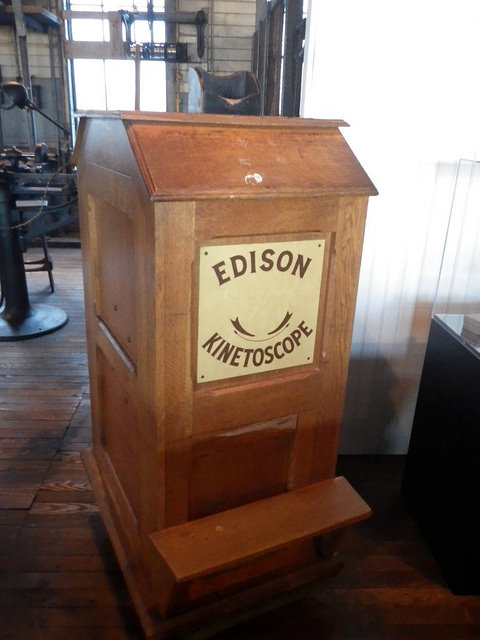
The Edison kinetoscope.
todd.vision – Kinetoscope – CC BY 2.0.
Equally the kinetoscope gained popularity, the Edison Visitor began installing machines in hotel lobbies, amusement parks, and penny arcades, and shortly kinetoscope parlors—where customers could pay around 25 cents for access to a banking concern of machines—had opened effectually the country. However, when friends and collaborators suggested that Edison discover a style to project his kinetoscope images for audience viewing, he apparently refused, claiming that such an invention would be a less profitable venture (Britannica).
Considering Edison hadn't secured an international patent for his invention, variations of the kinetoscope were soon being copied and distributed throughout Europe. This new grade of entertainment was an instant success, and a number of mechanics and inventors, seeing an opportunity, began toying with methods of projecting the moving images onto a larger screen. Nonetheless, information technology was the invention of ii brothers, Auguste and Louis Lumière—photographic goods manufacturers in Lyon, France—that saw the most commercial success. In 1895, the brothers patented the cinématographe (from which we get the term movie house), a lightweight film projector that too functioned every bit a camera and printer. Unlike the Edison kinetograph, the cinématographe was lightweight plenty for easy outdoor filming, and over the years the brothers used the photographic camera to take well over 1,000 brusk films, almost of which depicted scenes from everyday life. In December 1895, in the basement lounge of the Grand Café, Rue des Capucines in Paris, the Lumières held the world's first always commercial picture screening, a sequence of nigh 10 curt scenes, including the brother's first moving-picture show, Workers Leaving the Lumière Factory, a segment lasting less than a infinitesimal and depicting workers leaving the family's photographic instrument factory at the end of the day, every bit shown in the still frame here in Figure viii.iii (Encyclopedia of the Age of Industry and Empire).
Assertive that audiences would become bored watching scenes that they could just as easily observe on a casual walk around the metropolis, Louis Lumière claimed that the cinema was "an invention without a future (Menand, 2005)," just a need for motion pictures grew at such a rapid rate that soon representatives of the Lumière company were traveling throughout Europe and the world, showing one-half-60 minutes screenings of the company's films. While cinema initially competed with other pop forms of entertainment—circuses, vaudeville acts, theater troupes, magic shows, and many others—eventually it would supplant these various entertainments as the primary commercial attraction (Menand, 2005). Within a year of the Lumières' first commercial screening, competing moving picture companies were offer moving-picture acts in music halls and vaudeville theaters beyond Great United kingdom. In the The states, the Edison Company, having purchased the rights to an improved projector that they called the Vitascope, held their first film screening in April 1896 at Koster and Bial'southward Music Hall in Herald Square, New York City.
Film's profound touch on on its earliest viewers is difficult to imagine today, inundated equally many are past video images. Withal, the sheer book of reports well-nigh the early audience's disbelief, delight, and fifty-fifty fearfulness at what they were seeing suggests that viewing a motion-picture show was an overwhelming experience for many. Spectators gasped at the realistic details in films such as Robert Paul's Rough Body of water at Dover, and at times people panicked and tried to flee the theater during films in which trains or moving carriages sped toward the audience (Robinson). Fifty-fifty the public's perception of moving picture every bit a medium was considerably different from the gimmicky understanding; the moving image was an improvement upon the photograph—a medium with which viewers were already familiar—and this is perhaps why the earliest films documented events in brief segments but didn't tell stories. During this "novelty flow" of movie theater, audiences were more interested past the phenomenon of the flick projector itself, then vaudeville halls advertised the kind of projector they were using (for example "The Vitascope—Edison's Latest Curiosity") (Balcanasu, et. al.), rather than the names of the films (Britannica Online).
By the close of the 19th century, every bit public excitement over the picture show's novelty gradually wore off, filmmakers were also beginning to experiment with film's possibilities every bit a medium in itself (not only, every bit it had been regarded up until and then, as a tool for documentation, coordinating to the camera or the phonograph). Technical innovations allowed filmmakers like Parisian movie theatre owner Georges Méliès to experiment with special effects that produced seemingly magical transformations on screen: flowers turned into women, people disappeared with puffs of smoke, a man appeared where a woman had just been standing, and other similar tricks (Robinson).
Not just did Méliès, a sometime magician, invent the "trick moving picture," which producers in England and the United States began to imitate, but he was too the one to transform cinema into the narrative medium it is today. Whereas before, filmmakers had only ever created single-shot films that lasted a minute or less, Méliès began joining these short films together to create stories. His thirty-scene Trip to the Moon (1902), a film based on a Jules Verne novel, may have been the most widely seen production in cinema's commencement decade (Robinson). However, Méliès never developed his technique beyond treating the narrative flick as a staged theatrical performance; his camera, representing the vantage signal of an audience facing a stage, never moved during the filming of a scene. In 1912, Méliès released his last commercially successful product, The Conquest of the Pole, and from and then on, he lost audiences to filmmakers who were experimenting with more than sophisticated techniques (Encyclopedia of Communication and Information).
Figure 8.4
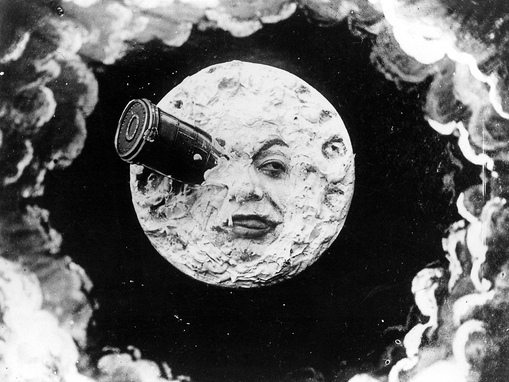
Georges Méliès'south Trip to the Moon was i of the first films to comprise fantasy elements and to use "fob" filming techniques, both of which heavily influenced future filmmakers.
Craig Duffy – Workers Leaving The Lumiere Factory – CC BY-NC 2.0.
The Nickelodeon Craze (1904–1908)
One of these innovative filmmakers was Edwin S. Porter, a projectionist and engineer for the Edison Company. Porter's 12-infinitesimal film, The Smashing Train Robbery (1903), broke with the stagelike compositions of Méliès-style films through its use of editing, camera pans, rear projections, and diagonally composed shots that produced a continuity of action. Not only did The Great Train Robbery establish the realistic narrative equally a standard in cinema, it was also the kickoff major box-office hit. Its success paved the manner for the growth of the film manufacture, as investors, recognizing the move picture'south great moneymaking potential, began opening the first permanent film theaters around the country.
Known as nickelodeons because of their 5 cent access charge, these early motion picture theaters, often housed in converted storefronts, were especially popular among the working class of the fourth dimension, who couldn't afford alive theater. Betwixt 1904 and 1908, around nine,000 nickelodeons appeared in the United states of america. It was the nickelodeon'southward popularity that established film as a mass amusement medium (Dictionary of American History).
The "Biz": The Motility Picture Manufacture Emerges
Every bit the demand for motility pictures grew, product companies were created to meet information technology. At the height of nickelodeon popularity in 1910 (Britannica Online), there were 20 or and so major motion picture companies in the United States. However, heated disputes ofttimes broke out among these companies over patent rights and industry command, leading even the virtually powerful among them to fear fragmentation that would loosen their hold on the marketplace (Fielding, 1967). Because of these concerns, the x leading companies—including Edison, Biograph, Vitagraph, and others—formed the Motion Picture Patents Company (MPPC) in 1908. The MPPC was a trade grouping that pooled the well-nigh pregnant motion picture patents and established an exclusive contract between these companies and the Eastman Kodak Visitor equally a supplier of film stock. Also known as the Trust, the MPPC's goal was to standardize the industry and shut out competition through monopolistic command. Under the Trust'south licensing system, but certain licensed companies could participate in the exchange, distribution, and production of picture show at dissimilar levels of the industry—a shut-out tactic that eventually backfired, leading the excluded, contained distributors to organize in opposition to the Trust (Britannica Online).
The Rising of the Feature
In these early on years, theaters were nonetheless running single-reel films, which came at a standard length of 1,000 feet, allowing for about 16 minutes of playing time. However, companies began to import multiple-reel films from European producers around 1907, and the format gained pop acceptance in the United States in 1912 with Louis Mercanton's highly successful Queen Elizabeth, a three-and-a-half reel "feature," starring the French actress Sarah Bernhardt. Every bit exhibitors began to show more than features—as the multiple-reel pic came to be called—they discovered a number of advantages over the single-reel short. For 1 thing, audiences saw these longer films as special events and were willing to pay more for admission, and because of the popularity of the feature narratives, features more often than not experienced longer runs in theaters than their single-reel predecessors (Move Pictures). Additionally, the characteristic picture gained popularity among the center classes, who saw its length as analogous to the more than "respectable" entertainment of live theater (Motion Pictures). Post-obit the example of the French moving-picture show d'art, U.Southward. characteristic producers often took their material from sources that would appeal to a wealthier and ameliorate educated audience, such every bit histories, literature, and stage productions (Robinson).
Every bit it turns out, the feature film was one gene that brought about the eventual downfall of the MPPC. The inflexible structuring of the Trust's exhibition and distribution system fabricated the organisation resistant to modify. When movie studio, and Trust member, Vitagraph began to release features like A Tale of Two Cities (1911) and Uncle Tom's Cabin (1910), the Trust forced it to exhibit the films serially in single-reel showings to keep with industry standards. The MPPC besides underestimated the entreatment of the star system, a trend that began when producers chose famous stage actors like Mary Pickford and James O'Neill to play the leading roles in their productions and to grace their advertising posters (Robinson). Because of the MPPC'south inflexibility, independent companies were the simply ones able to capitalize on two important trends that were to become film's future: single-reel features and star power. Today, few people would recognize names similar Vitagraph or Biograph, but the independents that outlasted them—Universal, Goldwyn (which would later merge with Metro and Mayer), Fox (later 20th Century Fox), and Paramount (the later version of the Lasky Corporation)—have become household names.
Hollywood
As moviegoing increased in popularity among the middle course, and as the feature films began keeping audiences in their seats for longer periods of time, exhibitors found a need to create more comfortable and richly decorated theater spaces to attract their audiences. These "dream palaces," so called because of their oftentimes lavish embellishments of marble, brass, guilding, and cutting glass, not only came to supplant the nickelodeon theater, only also created the demand that would lead to the Hollywood studio organization. Some producers realized that the growing demand for new work could simply be met if the films were produced on a regular, yr-round arrangement. However, this was impractical with the current system that often relied on outdoor filming and was predominately based in Chicago and New York—two cities whose weather weather condition prevented outdoor filming for a significant portion of the year. Unlike companies attempted filming in warmer locations such as Florida, Texas, and Cuba, but the place where producers eventually found the most success was a small, industrial suburb of Los Angeles called Hollywood.
Hollywood proved to be an ideal location for a number of reasons. Not only was the climate temperate and sunny twelvemonth-circular, but land was plentiful and cheap, and the location allowed shut access to a number of diverse topographies: mountains, lakes, desert, coasts, and forests. By 1915, more 60 percent of U.S. film production was centered in Hollywood (Britannica Online).
The Art of Silent Moving picture
While the development of narrative picture was largely driven by commercial factors, it is as well important to acknowledge the function of private artists who turned information technology into a medium of personal expression. The picture of the silent era was generally simplistic in nature; acted in overly animated movements to engage the eye; and accompanied past live music, played by musicians in the theater, and written titles to create a mood and to characterize a story. Within the confines of this medium, one filmmaker in particular emerged to transform the silent picture into an art and to unlock its potential as a medium of serious expression and persuasion. D. W. Griffith, who entered the motion-picture show manufacture as an role player in 1907, quickly moved to a directing part in which he worked closely with his camera crew to experiment with shots, angles, and editing techniques that could heighten the emotional intensity of his scenes. He found that by practicing parallel editing, in which a flick alternates between two or more scenes of action, he could create an illusion of simultaneity. He could then heighten the tension of the film's drama by alternating between cuts more and more rapidly until the scenes of action converged. Griffith used this technique to great outcome in his controversial flick The Nascence of a Nation, which will be discussed in greater detail after in this chapter. Other techniques that Griffith employed to new effect included panning shots, through which he was able to institute a sense of scene and to engage his audience more fully in the experience of the film, and tracking shots, or shots that traveled with the movement of a scene (Motion Pictures), which allowed the audition—through the eye of the camera—to participate in the film'due south activity.
MPAA: Combating Censorship
As picture became an increasingly lucrative U.S. industry, prominent industry figures like D. W. Griffith, slapstick comedian/manager Charlie Chaplin, and actors Mary Pickford and Douglas Fairbanks grew extremely wealthy and influential. Public attitudes toward stars and toward some stars' improvident lifestyles were divided, much as they are today: On the 1 hand, these celebrities were idolized and imitated in popular civilisation, however at the same time, they were criticized for representing a threat, on and off screen, to traditional morals and social guild. And much as it does today, the news media liked to sensationalize the lives of celebrities to sell stories. Comedian Roscoe "Fatty" Arbuckle, who worked alongside future icons Charlie Chaplin and Buster Keaton, was at the center of one of the biggest scandals of the silent era. When Arbuckle hosted a marathon party over Labor Twenty-four hours weekend in 1921, 1 of his guests, model Virginia Rapp, was rushed to the hospital, where she afterward died. Reports of a drunken orgy, rape, and murder surfaced. Following World War I, the U.s.a. was in the middle of significant social reforms, such as Prohibition. Many feared that movies and their stars could threaten the moral order of the country. Considering of the nature of the law-breaking and the glory involved, these fears became inexplicably tied to the Artbuckle case (Motion Pictures). Fifty-fifty though autopsy reports ruled that Rapp had died from causes for which Arbuckle could not be blamed, the comedian was tried (and acquitted) for manslaughter, and his career was ruined.
The Arbuckle affair and a series of other scandals simply increased public fears about Hollywood's affect. In response to this perceived threat, state and local governments increasingly tried to censor the content of films that depicted crime, violence, and sexually explicit material. Deciding that they needed to protect themselves from regime censorship and to foster a more favorable public image, the major Hollywood studios organized in 1922 to form an association they called the Motion Pic Producers and Distributers of America (later renamed the Motion Picture Association of America, or MPAA). Among other things, the MPAA instituted a code of cocky-censorship for the motion flick industry. Today, the MPAA operates by a voluntary rating organisation, which ways producers can voluntarily submit a film for review, which is designed to alert viewers to the age-appropriateness of a picture, while still protecting the filmmakers' creative freedom (Motion Motion picture Clan of America).
Silent Pic'due south Demise
In 1925, Warner Bros. was just a pocket-sized Hollywood studio looking for opportunities to aggrandize. When representatives from Western Electric offered to sell the studio the rights to a new technology they chosen Vitaphone, a audio-on-disc organization that had failed to capture the interest of any of the industry giants, Warner Bros. executives took a chance, predicting that the novelty of talking films might exist a way to make a quick, brusk-term profit. Little did they anticipate that their run a risk would not just constitute them as a major Hollywood presence merely too change the industry forever.
The pairing of sound with motion pictures was nada new in itself. Edison, after all, had deputed the kinetoscope to create a visual accompaniment to the phonograph, and many early theaters had orchestra pits to provide musical accessory to their films. Even the smaller picture houses with lower budgets almost always had an organ or piano. When Warner Bros. purchased Vitaphone technology, it planned to use it to provide prerecorded orchestral accompaniment for its films, thereby increasing their marketability to the smaller theaters that didn't take their own orchestra pits (Gochenour, 2000). In 1926, Warner debuted the arrangement with the release of Don Juan, a costume drama accompanied by a recording of the New York Philharmonic Orchestra; the public responded enthusiastically (Motion Pictures). By 1927, afterward a $iii meg campaign, Warner Bros. had wired more than than 150 theaters in the United States, and it released its second audio film, The Jazz Vocalist, in which the histrion Al Jolson improvised a few lines of synchronized dialogue and sang six songs. The film was a major breakthrough. Audiences, hearing an role player speak on screen for the beginning fourth dimension, were enchanted (Gochenour). While radio, a new and popular entertainment, had been cartoon audiences away from the flick houses for some time, with the nascence of the "talkie," or talking picture, audiences over again returned to the cinema in big numbers, lured by the promise of seeing and hearing their idols perform (Higham, 1973). By 1929, three-fourths of Hollywood films had some form of sound accompaniment, and by 1930, the silent motion picture was a thing of the past (Gochenour).
"I Don't Think We're in Kansas Anymore": Film Goes Technicolor
Although the techniques of tinting and hand painting had been available methods for adding color to films for some time (Georges Méliès, for instance, employed a coiffure to hand-paint many of his films), neither method ever caught on. The hand-painting technique became impractical with the appearance of mass-produced motion-picture show, and the tinting process, which filmmakers discovered would create an interference with the transmission of audio in films, was abandoned with the rise of the talkie. However, in 1922, Herbert Kalmus'southward Technicolor company introduced a dye-transfer technique that allowed it to produce a full-length movie, The Toll of the Bounding main, in two principal colors (Gale Virtual Reference Library). Still, considering only ii colors were used, the appearance of The Toll of the Bounding main (1922), The Ten Commandments (1923), and other early Technicolor films was non very lifelike. By 1932, Technicolor had designed a three-colour arrangement with more realistic results, and for the next 25 years, all color films were produced with this improved system. Disney's Three Piddling Pigs (1933) and Snow White and the Vii Dwarves (1936) and films with live actors, like MGM'southward The Wizard of Oz (1939) and Gone With the Wind (1939), experienced early on success using Technicolor'due south iii-colour method.
Despite the success of sure colour films in the 1930s, Hollywood, similar the rest of the United States, was feeling the impact of the Great Depression, and the expenses of special cameras, crews, and Technicolor lab processing fabricated colour films impractical for studios trying to cut costs. Therefore, it wasn't until the finish of the 1940s that Technicolor would largely displace the black-and-white film (Motility Pictures in Color).
Rise and Fall of the Hollywood Studio
The spike in theater attendance that followed the introduction of talking films changed the economic construction of the motion picture industry, bringing near some of the largest mergers in industry history. By 1930, eight studios produced 95 percent of all American films, and they continued to experience growth even during the Depression. The 5 most influential of these studios—Warner Bros., Metro-Goldwyn-Mayer, RKO, 20th Century Fob, and Paramount—were vertically integrated; that is, they controlled every part of the system as information technology related to their films, from the product to release, distribution, and fifty-fifty viewing. Because they endemic theater chains worldwide, these studios controlled which movies exhibitors ran, and because they "owned" a stock of directors, actors, writers, and technical assistants by contract, each studio produced films of a particular character.
The late 1930s and early 1940s are sometimes known every bit the "Gilt Age" of movie house, a time of unparalleled success for the picture industry; past 1939, picture show was the 11th-largest manufacture in the U.s.a., and during World War Two, when the U.S. economy was once again flourishing, two-thirds of Americans were attending the theater at least once a calendar week (Britannica Online). Some of the well-nigh acclaimed movies in history were released during this period, including Denizen Kane and The Grapes of Wrath. Still, postwar inflation, a temporary loss of key foreign markets, the advent of the goggle box, and other factors combined to bring that rapid growth to an finish. In 1948, the instance of the The states v. Paramount Pictures—mandating competition and forcing the studios to relinquish control over theater chains—dealt the last devastating blow from which the studio system would never recover. Command of the major studios reverted to Wall Street, where the studios were eventually captivated by multinational corporations, and the powerful studio heads lost the influence they had held for almost 30 years (Baers, 2000).
Figure eight.5
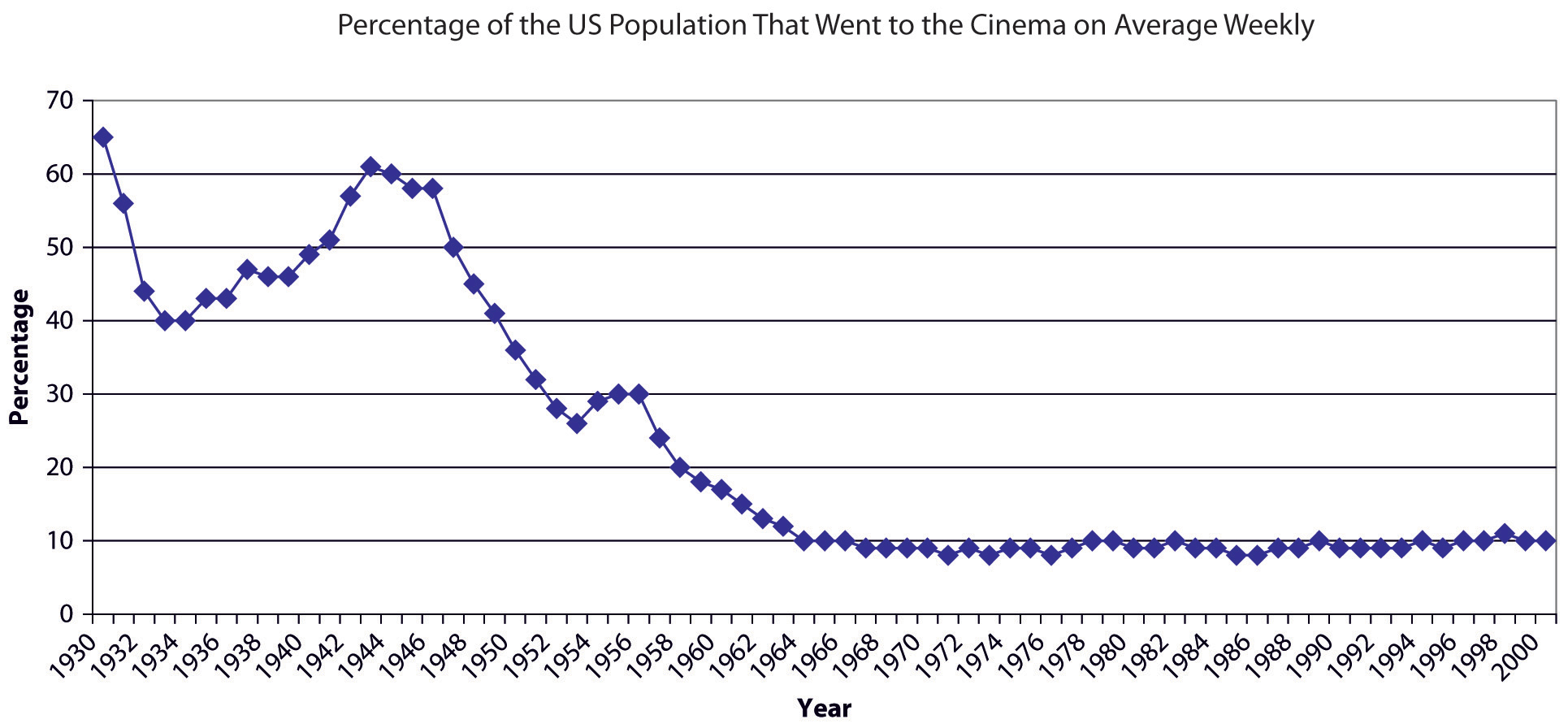
Ascent and Decline of Motion picture Viewing During Hollywood'southward "Gilt Age"
Graph from Pautz, Michelle C. 2002. The Turn down in Average Weekly Movie house Attendance: 1930–2000. Issues in Political Economy, 11 (Summertime): 54–65.
Post–World War Two: Tv set Presents a Threat
While economic factors and antitrust legislation played key roles in the decline of the studio system, maybe the virtually important cistron in that decline was the advent of the television. Given the opportunity to spotter "movies" from the comfort of their own homes, the millions of Americans who owned a tv set past the early 1950s were attending the picture palace far less regularly than they had but several years before (Movement Pictures). In an attempt to win dorsum diminishing audiences, studios did their best to exploit the greatest advantages film held over television receiver. For one thing, television set broadcasting in the 1950s was all in blackness and white, whereas the film industry had the advantage of color. While producing a color picture show was still an expensive undertaking in the late 1940s, a couple of changes occurred in the industry in the early 1950s to brand colour non only more affordable, but more than realistic in its appearance. In 1950, every bit the result of antitrust legislation, Technicolor lost its monopoly on the color motion-picture show industry, allowing other providers to offering more than competitive pricing on filming and processing services. At the same time, Kodak came out with a multilayer film stock that fabricated it possible to use more affordable cameras and to produce a college quality prototype. Kodak's Eastmancolor option was an integral component in converting the manufacture to color. In the late 1940s, just 12 percent of features were in color; withal, by 1954 (subsequently the release of Kodak Eastmancolor) more than 50 percent of movies were in color (Britannica Online).
Another clear advantage on which filmmakers tried to capitalize was the sheer size of the movie theater experience. With the release of the ballsy biblical film The Robe in 1953, 20th Century Play tricks introduced the method that would soon exist adopted by nearly every studio in Hollywood: a technology that allowed filmmakers to squeeze a wide-angle epitome onto conventional 35-mm motion picture stock, thereby increasing the aspect ratio (the ratio of a screen's width to its height) of their images. This wide-screen format increased the immersive quality of the theater feel. Notwithstanding, even with these advancements, movie attendance never over again reached the record numbers it experienced in 1946, at the peak of the Gilded Age of Hollywood (Britannica Online).
Mass Entertainment, Mass Paranoia: HUAC and the Hollywood Blacklist
The Cold War with the Soviet Matrimony began in 1947, and with it came the widespread fear of communism, non simply from the outside, but equally from within. To undermine this perceived threat, the House Un-American Activities Committee (HUAC) commenced investigations to locate communist sympathizers in America who were suspected of conducting espionage for the Soviet Union. In the highly conservative and paranoid atmosphere of the fourth dimension, Hollywood, the source of a mass-cultural medium, came under fire in response to fears that subversive, communist messages were being embedded in films. In November 1947, more than than 100 people in the motion-picture show business organisation were called to testify before the HUAC about their and their colleagues' involvement with communist affairs. Of those investigated, 10 in item refused to cooperate with the committee'south questions. These x, later known as the Hollywood Ten, were fired from their jobs and sentenced to serve up to a year in prison house. The studios, already slipping in influence and profit, were eager to cooperate in order to salvage themselves, and a number of producers signed an agreement stating that no communists would work in Hollywood.
The hearings, which recommenced in 1951 with the rise of Senator Joseph McCarthy's influence, turned into a kind of witch chase as witnesses were asked to show against their associates, and a blacklist of suspected communists evolved. Over 324 individuals lost their jobs in the film industry as a effect of blacklisting (the deprival of work in a certain field or industry) and HUAC investigations (Georgakas, 2004; Mills, 2007; Dressler, et. al., 2005).
Down With the Establishment: Youth Culture of the 1960s and 1970s
Movies of the belatedly 1960s began attracting a younger demographic, as a growing number of young people were drawn in by films like Sam Peckinpah's The Wild Bunch (1969), Stanley Kubrick's 2001: A Space Odyssey (1968), Arthur Penn's Bonnie and Clyde (1967), and Dennis Hopper's Easy Passenger (1969)—all revolutionary in their genres—that displayed a sentiment of unrest toward conventional social orders and included some of the earliest instances of realistic and brutal violence in movie. These four films in particular grossed and so much money at the box offices that producers began churning out low-budget copycats to draw in a new, profitable market (Motion Pictures). While this led to a ascent in youth-civilisation films, few of them saw groovy success. However, the new liberal attitudes toward depictions of sex and violence in these films represented a sea of change in the moving picture manufacture that manifested in many movies of the 1970s, including Francis Ford Coppola's The Godfather (1972), William Friedkin's The Exorcist (1973), and Steven Spielberg's Jaws (1975), all three of which saw cracking fiscal success (Britannica Online; Belton, 1994).
Blockbusters, Knockoffs, and Sequels
In the 1970s, with the rise of work past Coppola, Spielberg, George Lucas, Martin Scorsese, and others, a new breed of director emerged. These directors were young and film-school educated, and they contributed a sense of professionalism, sophistication, and technical mastery to their work, leading to a wave of blockbuster productions, including Close Encounters of the 3rd Kind (1977), Star Wars (1977), Raiders of the Lost Ark (1981), and E.T.: The Extra-Terrestrial (1982). The calculator-generated special effects that were bachelor at this time too contributed to the success of a number of large-budget productions. In response to these and several earlier blockbusters, movie production and marketing techniques also began to shift, with studios investing more coin in fewer films in the hopes of producing more big successes. For the first time, the hefty sums producers and distributers invested didn't become to production costs alone; distributers were discovering the benefits of TV and radio ad and finding that doubling their ad costs could increase profits as much equally three or iv times over. With the opening of Jaws, one of the five top-grossing films of the decade (and the highest grossing film of all time until the release of Star Wars in 1977), Hollywood embraced the wide-release method of picture distribution, abandoning the release methods of before decades, in which a movie would debut in only a handful of select theaters in major cities before it became gradually available to mass audiences. Jaws was released in 600 theaters simultaneously, and the big-budget films that followed came out in anywhere from 800 to 2,000 theaters nationwide on their opening weekends (Belton; Hanson & Garcia-Myers, 2000).
The major Hollywood studios of the late 1970s and early 1980s, at present run past international corporations, tended to favor the bourgeois risk of the tried and truthful, and every bit a result, the menses saw an unprecedented number of high-budget sequels—as in the Star Wars, Indiana Jones, and Godfather films—equally well as imitations and adaptations of earlier successful material, such as the plethora of "slasher" films that followed the success of the 1979 thriller Halloween. Additionally, corporations sought revenue sources across the motion-picture show theater, looking to the video and cable releases of their films. Introduced in 1975, the VCR became nearly ubiquitous in American homes past 1998 with 88.9 one thousand thousand households owning the appliance (Rosen & Meier, 2000). Cable goggle box's growth was slower, but ownership of VCRs gave people a new reason to subscribe, and cable subsequently expanded also (Rogers). And the newly introduced concept of film-based merchandise (toys, games, books, etc.) allowed companies to increase profits fifty-fifty more.
The 1990s and Across
The 1990s saw the rise of 2 divergent strands of cinema: the technically spectacular blockbuster with special, reckoner-generated effects and the independent, low-budget film. The capabilities of special furnishings were enhanced when studios began manipulating picture digitally. Early examples of this technology can be seen in Terminator 2: Judgment Twenty-four hours (1991) and Jurassic Park (1993). Films with an epic scope—Independence Mean solar day (1996), Titanic (1997), and The Matrix (1999)—as well employed a range of calculator-animation techniques and special furnishings to wow audiences and to draw more than viewers to the big screen. Toy Story (1995), the first fully computer-animated film, and those that came after it, such as Antz (1998), A Problems'due south Life (1998), and Toy Story 2 (1999), displayed the improved capabilities of estimator-generated animation (Sedman, 2000). At the aforementioned time, independent directors and producers, such as the Coen brothers and Spike Jonze, experienced an increased popularity, often for lower-upkeep films that audiences were more than likely to watch on video at dwelling (Britannica Online). A prime instance of this is the 1996 Academy Awards program, when independent films dominated the Best Picture category. Only one picture show from a big film studio was nominated—Jerry Maguire—while the remainder were independent films. The growth of both independent movies and special-effects-laden blockbusters continues to the nowadays twenty-four hour period. You will read more than about current bug and trends and the future of the movie industry later on in this chapter.
Cardinal Takeaways
- The concept of the move flick was commencement introduced to a mass audition through Thomas Edison's kinetoscope in 1891. Nonetheless, it wasn't until the Lumière brothers released the cinématographe in 1895 that motion pictures were projected for audience viewing. In the United States, movie established itself every bit a popular form of entertainment with the nickelodeon theater in the 1910s.
- The release of The Jazz Singer in 1927 marked the birth of the talking motion picture, and by 1930 silent film was a thing of the by. Technicolor emerged for flick around the aforementioned fourth dimension and constitute early success with movies like The Wizard of Oz and Gone With the Air current. However, people would continue to make films in black and white until the late 1950s.
- By 1915 nigh of the major film studios had moved to Hollywood. During the Golden Age of Hollywood, these major studios controlled every aspect of the picture industry, and the films they produced drew crowds to theaters in numbers that have withal not been surpassed. Afterward World War 2, the studio system declined as a result of antitrust legislation that took power away from studios and of the invention of the idiot box.
- During the 1960s and 1970s, there was a rise in films—including Bonnie and Clyde, The Wild Bunch, 2001: A Space Odyssey, and Easy Rider—that celebrated the emerging youth civilisation and a rejection of the conservatism of the previous decades. This also led to looser attitudes toward depictions of sexuality and violence in picture show. The 1970s and 1980s saw the rise of the blockbuster, with films like Jaws, Star Wars, Raiders of the Lost Ark, and The Godfather.
- The adoption of the VCR by near households in the 1980s reduced audiences at movie theaters but opened a new mass market of abode motion picture viewers. Improvements in computer animation led to more special effects in film during the 1990s with movies like The Matrix, Jurassic Park, and the first fully computer-blithe film, Toy Story.
Exercises
Identify 4 films that yous would consider to be representative of major developments in the industry and in film as a medium that were outlined in this section. Imagine you lot are using these films to explain movie history to a friend. Provide a detailed explanation of why each of these films represents significant changes in attitudes, technology, or trends and situate each in the overall context of picture show's evolution. Consider the following questions:
- How did this movie influence the film industry?
- What has been the lasting impact of this moving-picture show on the film industry?
- How was the picture show industry and technology different before this picture show?
References
Baers, Michael. "Studio System," in St. James Encyclopedia of Popular Civilization, ed. Sara Pendergast and Tom Pendergast (Detroit: St. James Printing, 2000), vol. 4, 565.
Balcanasu, Andrei Ionut, Sergey V. Smagin, and Stephanie K. Thrift, "Edison and the Lumiere Brothers," Cartoons and Picture palace of the 20th Century, http://library.thinkquest.org/C0118600/index.phtml?menu=en%3B1%3Bci1001.html.
Belton, American Cinema/American Civilization, 305.
Belton, John. American Cinema/American Culture. (New York: McGraw-Loma, 1994), 284–290.
Britannica Online, s.v. "History of the Motion Picture".
Britannica Online, s.v. "Kinetoscope," http://www.britannica.com/EBchecked/topic/318211/Kinetoscope/318211main/Commodity.
Britannica Online, s.5. "nickelodeon."
Britannica Online. s.v. "History of the Motility Picture." http://www.britannica.com/EBchecked/topic/394161/history-of-the-motion flick; Robinson, From Peep Bear witness to Palace, 45, 53.
British Motion-picture show Classics, "The Kinetoscope," British Picture show Classics, http://www.britishmovieclassics.com/thekinetoscope.php.
Dictionary of American History, 3rd ed., s.5. "Nickelodeon," by Ryan F. Holznagel, Gale Virtual Reference Library.
Dresler, Kathleen, Kari Lewis, Tiffany Schoser and Cathy Nordine, "The Hollywood Ten," Dalton Trumbo, 2005, http://www.mcpld.org/trumbo/WebPages/hollywoodten.htm.
Encyclopedia of Advice and Data (New York: MacMillan Reference USA, 2002), southward.v. "Méliès, Georges," by Ted C. Jones, Gale Virtual Reference Library.
Encyclopedia of the Age of Industry and Empire, due south.v. "Cinema."
Fielding, Raymond A Technological History of Movement Pictures and Television (Berkeley: California Univ. Printing, 1967) 21.
Gale Virtual Reference Library, "Motion Pictures in Color," in American Decades, ed. Judith South. Baughman and others, vol. 3, Gale Virtual Reference Library.
Gale Virtual Reference Library, Europe 1789–1914: Encyclopedia of the Historic period of Manufacture and Empire, vol. 1, s.v. "Picture palace," by Alan Williams, Gale Virtual Reference Library.
Georgakas, Dan. "Hollywood Blacklist," in Encyclopedia of the American Left, ed. Mari Jo Buhle, Paul Buhle, and Dan Georgakas, 2004, http://writing.upenn.edu/~afilreis/50s/blacklist.html.
Gochenour, "Nativity of the 'Talkies,'" 578.
Gochenour, Phil. "Nascency of the 'Talkies': The Development of Synchronized Sound for Motion Pictures," in Science and Its Times, vol. 6, 1900–1950, ed. Neil Schlager and Josh Lauer (Detroit: Gale, 2000), 577.
Hanson, Steve and Sandra Garcia-Myers, "Blockbusters," in St. James Encyclopedia of Pop Civilisation, ed. Sara Pendergast and Tom Pendergast (Detroit: St. James Press, 2000), vol. 1, 282.
Higham, Charles. The Fine art of the American Film: 1900–1971. (Garden City: Doubleday & Visitor, 1973), 85.
Menand, Louis "Gross Points," New Yorker, February 7, 2005, http://www.newyorker.com/archive/2005/02/07/050207crat_atlarge.
Mills, Michael. "Blacklist: A Different Look at the 1947 HUAC Hearings," Mod Times, 2007, http://www.moderntimes.com/blacklist/.
Move Picture Association of America, "History of the MPAA," http://www.mpaa.org/about/history.
Motion Pictures in Color, "Motion Pictures in Colour."
Motility Pictures, "Griffith," Motion Pictures, http://www.uv.es/EBRIT/macro/macro_5004_39_6.html#0011.
Movement Pictures, "Post World War I Us Cinema," Motility Pictures, http://www.uv.es/EBRIT/macro/macro_5004_39_10.html#0015.
Movement Pictures, "Pre World War Two Audio Era: Introduction of Audio," Motion Pictures, http://world wide web.uv.es/EBRIT/macro/macro_5004_39_11.html#0017.
Motion Pictures, "Pre Globe-War I U.s.a. Movie house," Motion Pictures: The Silent Feature: 1910-27, http://www.uv.es/EBRIT/macro/macro_5004_39_4.html#0009.
Motion Pictures, "Recent Trends in Us Cinema," Motion Pictures, http://www.uv.es/EBRIT/macro/macro_5004_39_37.html#0045.
Motility Pictures, "The War Years and Post World War 2 Trends: Reject of the Hollywood Studios," Move Pictures, http://www.uv.es/EBRIT/macro/macro_5004_39_24.html#0030.
Robinson, From Peep Evidence to Palace, 135, 144.
Robinson, From Peep Testify to Palace, 63.
Robinson, From Peep Show to Palace, 74–75; Encyclopedia of the Historic period of Industry and Empire, s.v. "Cinema."
Robinson, David. From Peep Show to Palace: The Birth of American Film (New York: Columbia Academy Press, 1994), 43–44.
Rogers, Everett. "Video is Here to Stay," Center for Media Literacy, http://www.medialit.org/reading-room/video-here-stay.
Rosen, Karen and Alan Meier, "Power Measurements and National Energy Consumption of Televisions and Video Cassette Recorders in the Us," Free energy, 25, no. 3 (2000), 220.
Sedman, David. "Movie Industry, Technology of," in Encyclopedia of Communication and Information, ed. Jorge Reina Schement (New York: MacMillan Reference, 2000), vol. 1, 340.
hamiltonainal1983.blogspot.com
Source: https://open.lib.umn.edu/mediaandculture/chapter/8-2-the-history-of-movies/
0 Response to "Nickelodeon 3d Movie Maker Could Not Start You May Need to Run Setup Again"
Postar um comentário